Progress
The Progress page shows where your listening level stands and how your sub-skills are moving — all based on real data from the exercises you've done, not on what you report yourself. At the heart of this page is a hidden number called θ (theta), and understanding how θ works will help you see why the level bar inches forward or stays put.
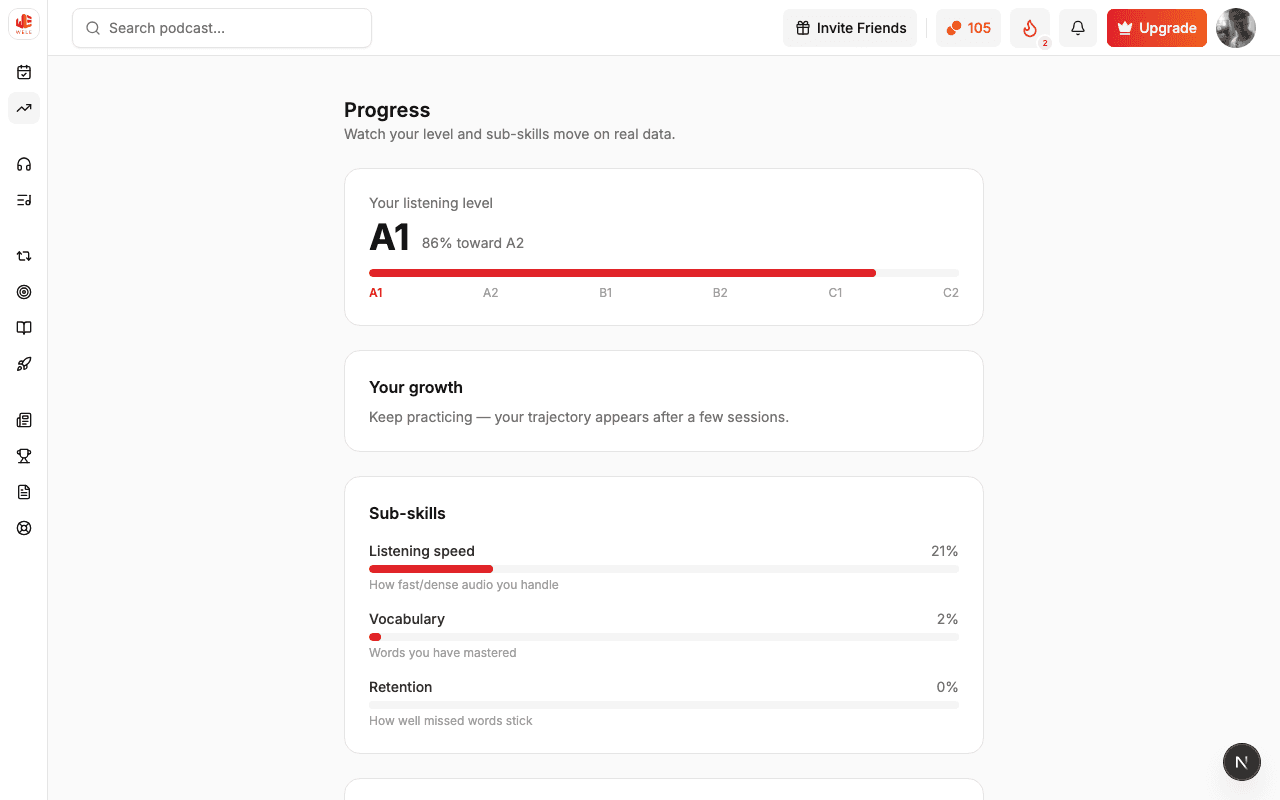
Listening level on the CEFR scale
Your level is shown on the CEFR scale: A1 · A2 · B1 · B2 · C1 · C2, with a percentage toward the next band (for example "A2 — 3% to B1"). Behind that number is θ, a hidden ability value on a logit scale (from -4 to 4). Every dictation is like a "match" between your ability θ and the exercise's difficulty d: the system predicts in advance roughly how much you'll get right (based on the gap θ − d); if you do BETTER than predicted, θ goes up, and if you do WORSE, θ goes down. It's exactly the principle behind the Elo rating in chess.
Because θ moves according to SURPRISE relative to the prediction, an easy exercise barely moves θ once you're already good (you were expected to get almost everything right), but beating a hard one does. On top of that, in your first exercises θ is still "soft" and moves quickly so the system can pin down your level fast; the more you do, the more θ settles. If you take a long break and come back, θ is loosened again to recalibrate quickly, in case your level changed while you were away.
Why only moving UP a band is celebrated
θ maps to bands at fixed thresholds. When your θ crosses a threshold into a higher band, WELE celebrates that milestone. But a temporary dip in θ will NEVER be announced as "dropping a level".
Why? Because θ is naturally noisy — a tired session or an unfamiliar topic can pull it down for a moment before it bounces back. Telling you "you dropped a level" over a passing fluctuation would discourage you for no good reason. The system also has a "damper": if θ hovers around a threshold, that band-up milestone is celebrated only ONCE, not every time you happen to cross the line and slip back. In short: progress gets celebrated, and noise gets quietly ignored.
Sub-skills
- Listening speed — how fast and dense the audio you can handle is.
- Vocabulary — how many words you've truly mastered.
- Retention — how well the words you once got wrong are sticking.
Everyday English coverage
The "Everyday English coverage" score answers this: what percentage of everyday spoken English do the words you own cover? The key point: it does NOT count words — it adds up the "frequency weight" of those words.
Why doesn't a figure like "~92%" contradict the fact that you only know a few thousand words? Because spoken English is extremely skewed: the few hundred most common words (the, be, have, go, people, want...) make up the BULK of everything said day to day, while tens of thousands of rare words together account for only a tiny share. Mastering the common core pushes coverage up very quickly; the last few percent are the hard part, because they're scattered across the long tail of rare words. This score creeps up week by week as your review cards graduate.
What to work on
"What to work on" groups your recurring mistakes by type (Omissions, Homophones, Spelling...) with a count for each. With Premium, you can turn these mistakes into personal coaching lessons. Because these error types come straight from the L1 classifier (see Dictation), they reflect the exact patterns your own ear keeps getting wrong.
Did you know
- The level bar moves with θ, and θ moves according to SURPRISE relative to the prediction — submitting an easy exercise when you're already good barely moves θ, but beating a hard one does.
- θ moves quickly in your first exercises (to place you), settles as you do more, and loosens again if you take a long break and come back.
- WELE only celebrates moving UP a band and never announces a drop — a passing θ fluctuation is never allowed to make you feel you're going backward, and each milestone is celebrated exactly once.
- Coverage adds up frequency weight instead of counting words: the few hundred most common words already make up most of everyday speech, so coverage climbs fast at first and slows down later.
- A word counts as "owned" (toward Vocabulary and Coverage) when you either transcribe it correctly and consistently (at least 3 times, with ≥ 80% accuracy) or its card graduates in FSRS.