Speaking
Speaking is a three-rung ladder that opens up gradually so you don't get overwhelmed. You start by shadowing a sentence, move on to answering in your own words, then to short conversations. The order shadowing → own words → conversation isn't arbitrary: it's scaffolding, with each rung building on the confidence you gained on the one before, so you're never thrown straight into the hardest part. Speaking is a Premium feature — because every attempt is scored by AI for pronunciation, sound by sound, you need to upgrade to Premium to unlock all three rungs.
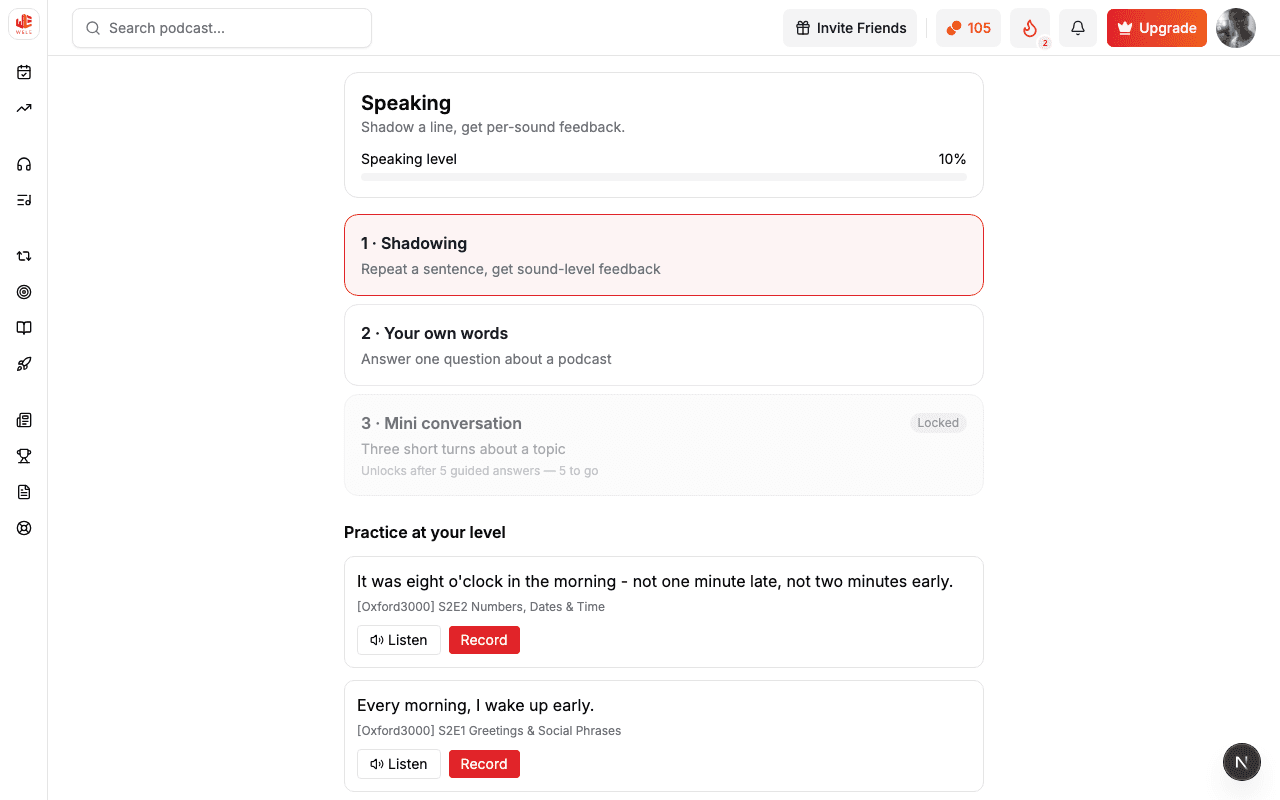
The three rungs, and why in that order
Each rung removes a bit more of the support. Shadowing hands you the whole sentence to imitate — you only have to worry about your mouth and the sounds. Your own words makes you come up with the content yourself, but still around a guiding question. Conversation adds real-time interaction. Going step by step like this helps you build confidence in pronunciation first, then content, then responding on the spot.
- Rung 1 · Shadowing — repeat a sentence and get feedback at the sound level. Always unlocked from the start.
- Rung 2 · Your own words — answer a question about a podcast in your own words.
- Rung 3 · Mini conversation — three short turns around a topic.
Unlock rules (exactly as the system uses them)
- Rung 2 unlocks after you complete 10 scored shadowing attempts.
- Rung 3 unlocks after you complete 5 own-words (guided) answers — and only once rung 2 is unlocked.
- Daily limits: up to 5 own-words answers, and 1 mini conversation per day.
- Each mini conversation has 3 turns (your partner opens, one follow-up turn, one closing turn) — and you speak in 2 of them.
Why there are daily limits
The limits of 5 own-words answers and 1 conversation per day serve two purposes at once. For you: producing spoken language is far more tiring than listening, so a moderate, steady daily dose works better than one crammed session followed by quitting. For the system: every attempt has to run speech recognition (ASR) and sometimes calls AI for scoring — operations that cost money — so a cap keeps this feature sustainably free for everyone.
Locked rungs are never hidden: they stay visible with the exact condition still missing (for example "5 more own-words answers to go"). That's intentional — showing you the finish line gives you motivation, instead of leaving you wondering why something hasn't unlocked yet.
Practice cards, the Listen button & reviewing weak words while speaking
"Practice at your level" offers sentence cards, each naming its source podcast (for example "[Oxford3000] S2E2 Numbers, Dates & Time"). Click "Listen" to hear the model sentence, then "Record" to say it back. On rung 2, the guided question always comes with a line showing which podcast episode it was taken from.
There's a hidden mechanism worth knowing about: in your FIRST own-words answer each day, WELE may slip in a word you owe a review on in FSRS, with the prompt "try to use this word in your answer". If you actually say that word, that use COUNTS AS a successful review for the source card. Why? Because using a word when you speak is an act of "retrieving" it from memory — the strongest form of review — so a single action both practices speaking and reinforces vocabulary, without any extra AI calls.
Did you know
- A locked rung is never vague — it always shows exactly how much is left (for example "5 more own-words answers to go"), to motivate you instead of keeping you guessing.
- The whole Speaking area only appears once your listening level reaches about B1 — it's an advanced "production" skill, not shown too early before your listening foundation is ready.
- The limits of 5 own-words answers/day and 1 conversation/day are deliberate: they keep you from overload and keep speech-processing and AI costs under control.
- Your first own-words answer each day may slip in a word you owe a review on — saying it is speaking practice and also counts as a review for the original FSRS card.