Dictation
Dictation is the heart of WELE. You listen segment by segment, type into the blanks, then hit Submit. What sets WELE apart is its "fair" grading: it understands real English instead of mechanically comparing character by character. The point of dictation is to train your EAR, so the system is designed not to penalize you for differences that have nothing to do with listening — like contractions or British vs. American spelling.
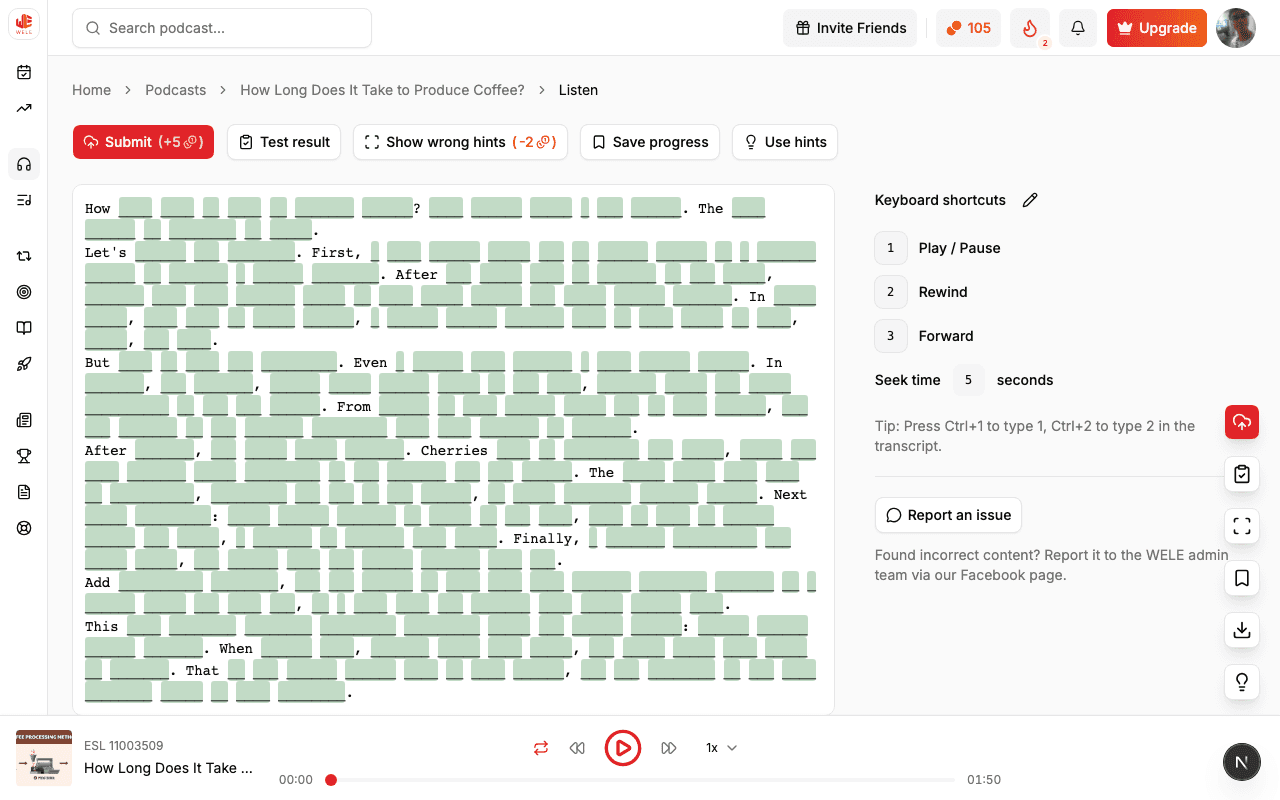
How to transcribe & the tools
The player at the bottom lets you rewind, skip forward, change speed (0.5x–2x) and seek by seconds. Keyboard shortcuts: 1 = play/pause, 2 = rewind, 3 = skip forward. Type into the blanks in the order they appear. A speed tip: drop to 0.75x to catch every consonant in fast passages, then listen again at normal speed to train your ear to keep up with the original pace — that's the speed you'll meet in real life.
The toolbar has a few helpers that cost coins: "Show wrong hints" (−2 coins), "View answer words" (−5 coins) and "Save progress" so you can come back later. These helpers cost coins on purpose — they shortcut the effort, and doing the work yourself is exactly what creates progress, so WELE adds a small "friction cost" so you only use them when you really need to.
Submitting
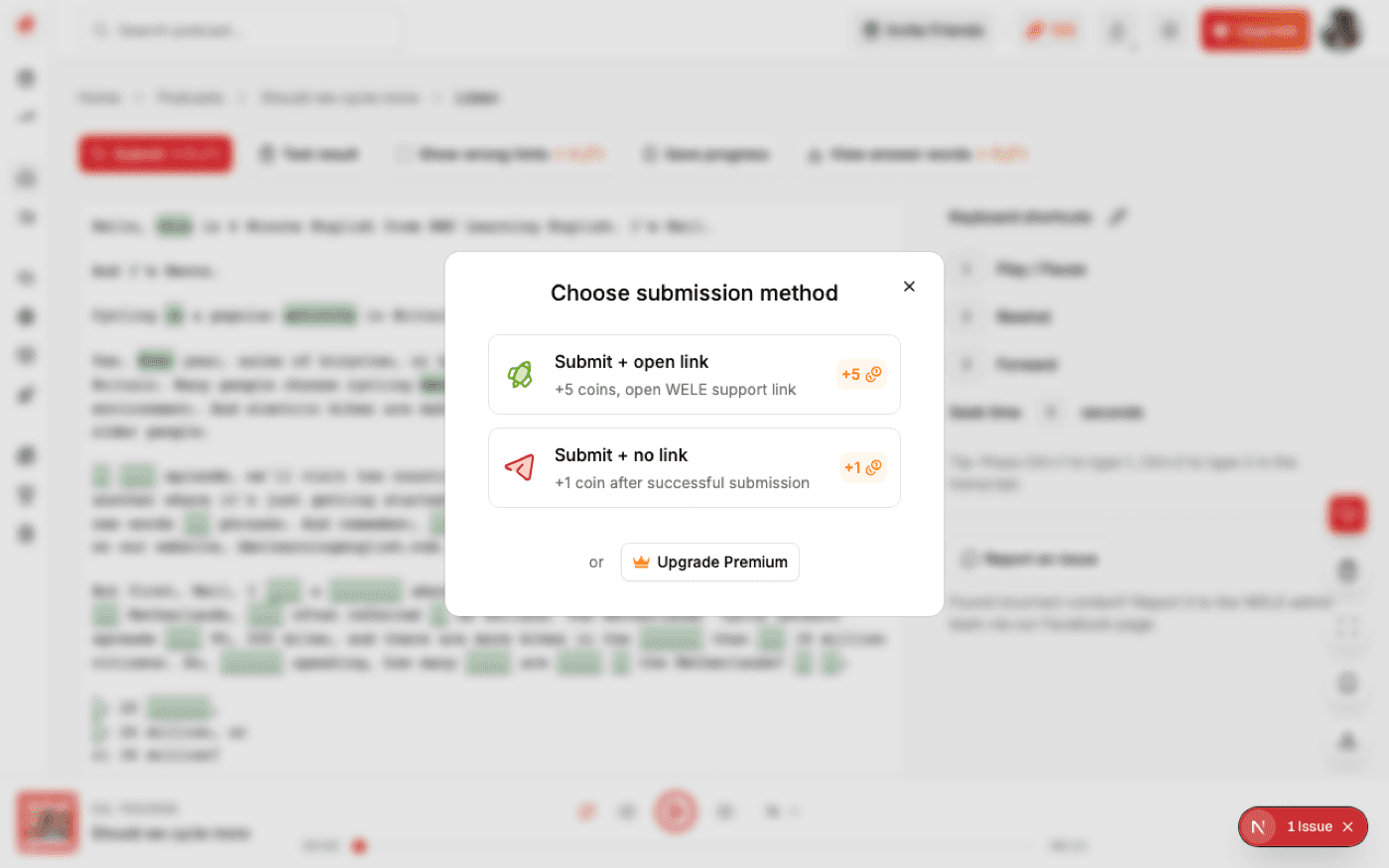
When you click Submit, WELE asks how you want to submit: "Submit + open link" (+5 coins, opens a WELE link) or "Submit + no link" (+1 coin). Premium users submit directly with no ads. Only your FIRST submission of an exercise is used to update your θ level — resubmissions deliberately don't count toward θ, so nobody can "farm points" by redoing an easy exercise over and over (see Progress).
Fair grading — a 4-step ladder
WELE doesn't penalize you for harmless differences. Your answers go through four processing levels, ordered from CHEAPEST to SMARTEST: each blank is resolved at the cheapest level possible, and only the genuinely hard cases climb to the more expensive levels. This ordering keeps grading fast, consistent and economical on AI costs.
- Level L0 — Equivalence: different spellings with the same meaning are all ACCEPTED. That includes contractions ("don't" = "do not", even slang like "gonna" = "going to"), homophones (23 groups such as "their/there/they're"), numbers written as words ("two" = "2", "first" = "1st") and British–American spelling variants ("colour" = "color"). This level is purely rule-based, with no AI, so it's practically instant.
- Level L1 — Classification: whatever is still wrong gets labeled as one of 7 error types (see below), with a short fix-it tip. This level is also purely rule-based — it uses a "phonetic key" and edit distance (Levenshtein) to work out what kind of mistake you made.
- Level L2 — AI adjudication: only the cases L1 marks as "hard to classify" (unknown) climb up here. An AI model reads the whole sentence for context and makes a ruling. Free users read results already stored in the shared cache; Premium triggers live adjudication. Each submission is capped at 5 adjudications to keep costs under control.
- Level L3 — Coach: a personal, warm explanation for each of your mistakes, worded to match your CEFR band. This is a Premium feature.
Why are homophones accepted?
Dictation trains your EAR, not your handwriting. If you hear "they left their bags" and type "there" instead of "their", then as far as LISTENING goes you were completely right — your ear caught the exact sound sequence /ðeə/. Taking points off here would punish you for a skill (spelling/grammar) this exercise isn't targeting at all. So WELE accepts the sound and only adds a "watch meaning" flag to remind you.
WELE stores 23 homophone groups — for example their/there/they're, your/you're, to/too/two, its/it's, hear/here, week/weak, know/no, write/right/rite, principal/principle. Within each group, every member counts as "the right sound".
Why draw the line there? It comes down to whether two words REALLY sound the same. Pairs like affect/effect or accept/except sound DIFFERENT (only similar), so they are DELIBERATELY left out of the homophone list — if you write "effect" when the answer is "affect", that's a sign your ear misheard, so the system teaches it as a "mishearing" error instead of letting it slide.
The 7 error types and their tips (exactly as the system uses them)
At level L1, every mistake is placed in exactly one type. The subtlest part is how WELE tells a "spelling error" apart from a "mishearing": if what you typed SOUNDS like the answer but is a REAL English word (like "effect" for "affect"), your ear caught the wrong word → mishearing; if it sounds alike but is NOT a real word (like "colur" for "colour"), your ear was right and you just typed the wrong letters → spelling error. That distinction decides which tip you get.
- Homophones: "Right sound, but check the meaning — these words sound the same but are used differently."
- Contractions: "Watch the contraction — the short and full forms mean the same thing."
- Spelling: "You heard it right — this is a spelling mistake. Check the letters."
- Mishearings: "This word sounds close to the target. Listen again carefully to the consonants and vowels."
- Omissions: "You left this blank. Try slowing the audio down and replaying this part."
- Word order: "Right word, wrong place — check the order of the words in the sentence." (detected when the word you typed is actually the answer to ANOTHER blank in the exercise).
- Other slips: "Compare your answer with the correct word and listen to this part again." — these are exactly the cases that get escalated to level L2 for AI review.
Why AI adjudication uses a shared cache
When a mistake climbs to level L2, WELE computes a "key" from the pair (answer + what you wrote) and looks it up in a cache shared by all learners. This serves two purposes. The first is COST: every AI call costs money, so if someone has already hit this exact near-miss, the result is reused instead of calling again. The second is CONSISTENCY: the same situation gets the same ruling for every learner — fair, with no luck of the draw from one call to the next.
Because the explanation is stored for everyone and shown to learners at every level, it's always written in simple B1-level language, with no grammar jargon. Free users only READ this shared cache; when a Premium user hits a case that isn't cached yet, it triggers a live AI call — and that result is saved, enriching the cache for everyone.
If there's no definitive ruling (a free user hits an uncached case, the 5-per-exercise limit is exceeded, or the AI's answer can't be read), that blank is NOT left hanging: it falls back to the L1 fix-it tip plus a prompt to unlock coaching. That way every near-miss always has at least one human-readable explanation.
Did you know
- Homophones are always COUNTED AS CORRECT in your score — WELE accepts the sound you heard and only reminds you to watch the meaning, because dictation grades LISTENING, not spelling.
- Easily confused pairs like affect/effect or accept/except are DELIBERATELY not treated as homophones — they sound different, so they're taught as "mishearing" errors instead of being ignored.
- The line between spelling and mishearing comes down to one question: is the word you typed a real English word? Real = you misheard it as a different word; not real = you heard it right and just mistyped.
- The AI adjudication cache is shared across the whole system, so free users almost always have an explanation ready for each near-miss — and every Premium AI call adds to that cache for everyone.
- Only "hard to classify" cases ever reach the AI, and each exercise is capped at 5 — so grading is thorough without driving up costs.