Review
Review is where words you got wrong are brought back at just the right moment to move them into long-term memory. WELE uses FSRS (Free Spaced Repetition Scheduler) — the same family of algorithms Anki uses. The core idea is the "spacing effect": memory is strengthened most when you recall a word just BEFORE you're about to forget it, not when you review too early (wasted effort) or too late (already forgotten).
How FSRS schedules reviews
For each word, FSRS estimates two quantities: stability (how long the memory lasts) and difficulty (how hard this word is for you in particular). Each time you recall it successfully, stability goes up, so the gap until the next review STRETCHES OUT — a few days the first time, then weeks, then months. That's why you review a word less and less often without forgetting it.
Each card moves through these states: New → Learning → Review. When a card "graduates" to Review, it means you truly own that word — and that's also the condition for it to count toward your coverage score on the Progress page.
Four ratings
For each card, you rate how well you remembered it, and the gap until the next review changes accordingly. These self-ratings are exactly the data FSRS uses to calibrate: being honest with yourself gives you a more accurate schedule.
- Again — you forgot; the card comes back soon (a "lapse" drops its stability).
- Hard — you remembered with a struggle; the interval grows less than expected.
- Good — you remembered fine; the interval grows as expected.
- Easy — you remembered instantly; the interval jumps, because the word is stronger than FSRS thought.
Why rare words are skipped when adding to review
Not every word you get wrong is worth reviewing. WELE sorts words into frequency tiers: tier 1 is the ~1000 most common words, then progressively rarer tiers, and finally words outside the list (proper names, rare terms). When mistakes are added to the queue automatically, very rare or off-list words are SKIPPED — unless you get them wrong several times, at which point they're considered worth reviewing.
Why? Because every minute of review is a limited resource. Mastering a common word (which you'll hear every day) is worth far more than a proper name you may never hear again. Filtering by frequency puts your review effort into the words that genuinely improve your listening.
Queue & management
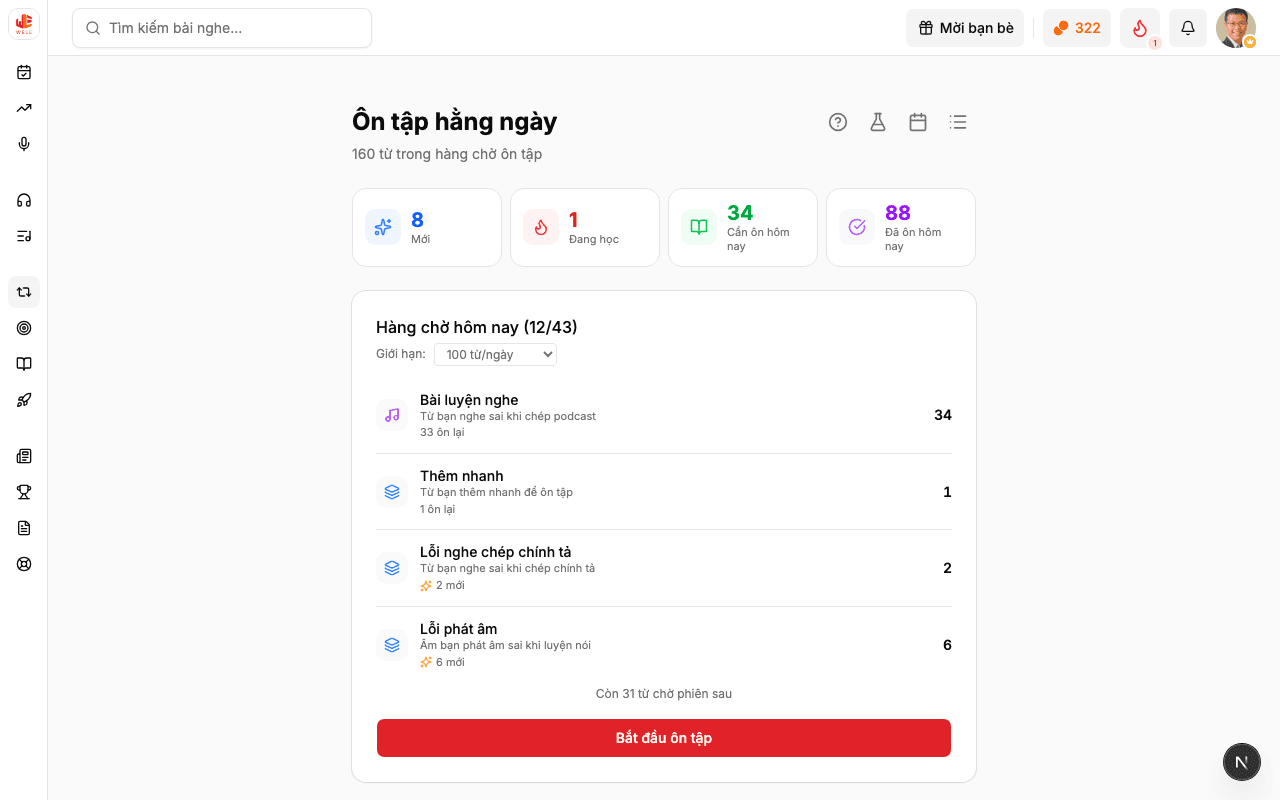
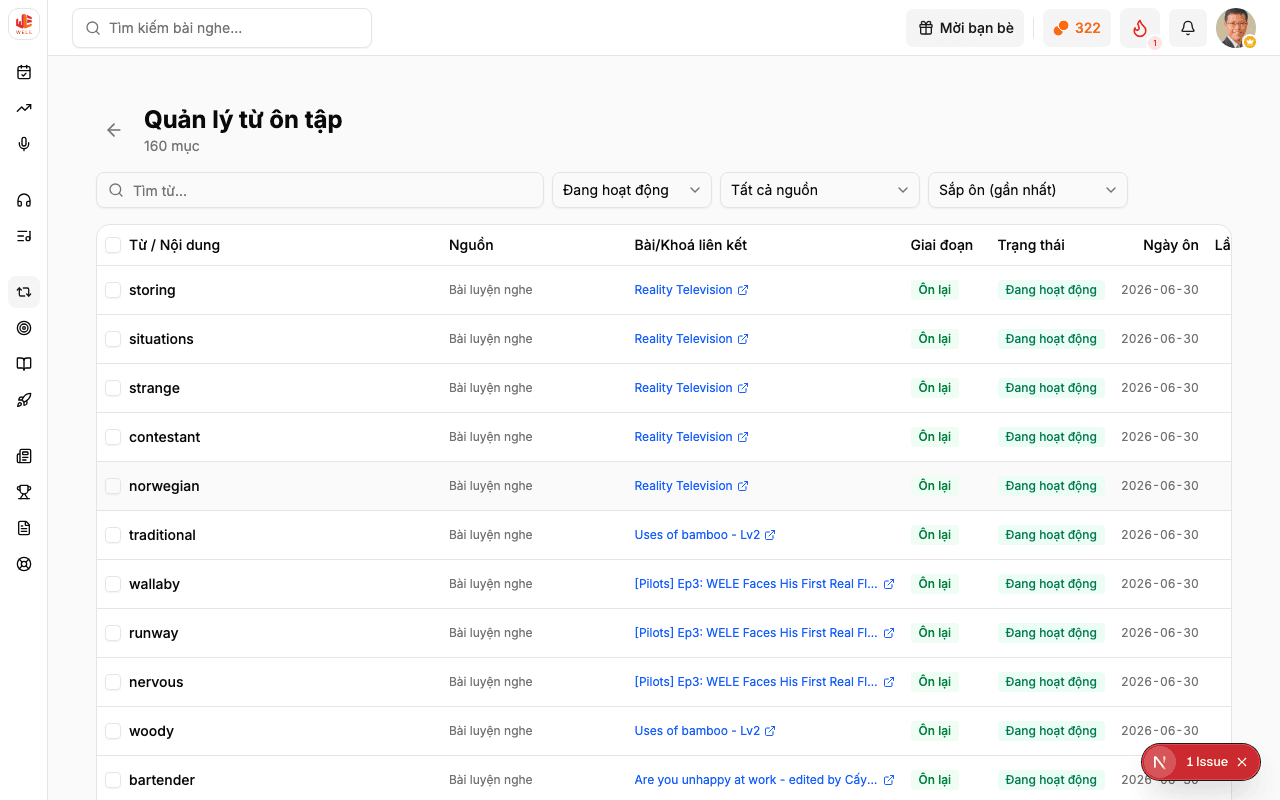
The Review page shows how many words are in your queue, how many are due today, and the breakdown of New / Learning / Due / Done today. "Manage Review Items" lists every word with its source, state, due date, repetitions (reps) and accuracy — so you can always see why a word is where it is.
Did you know
- Your review schedule isn't fixed: FSRS moves each card based on your own performance, so two people learning the same word will see it on different days.
- The gaps between reviews GROW exponentially as memory gets stronger — that's why you review less and less often and still remember, and also why a single "Again" brings a card back almost immediately.
- Very rare words and proper names are skipped when adding to review automatically (unless you get them wrong several times) — your review time goes to common, high-value words.
- A word only counts as "owned" once its card graduates to the Review state — which is also the condition for it to count toward coverage on the Progress page.
- Full FSRS smart scheduling is a Premium feature; the free version still lets you review, but without timing optimization.