Goals
Goals help you turn learning into a commitment with a reward — and quietly tilt your listening recommendations toward what you're aiming for. But that "tilt" has carefully set limits, and understanding those limits is the key to not letting a goal pull your learning off course.
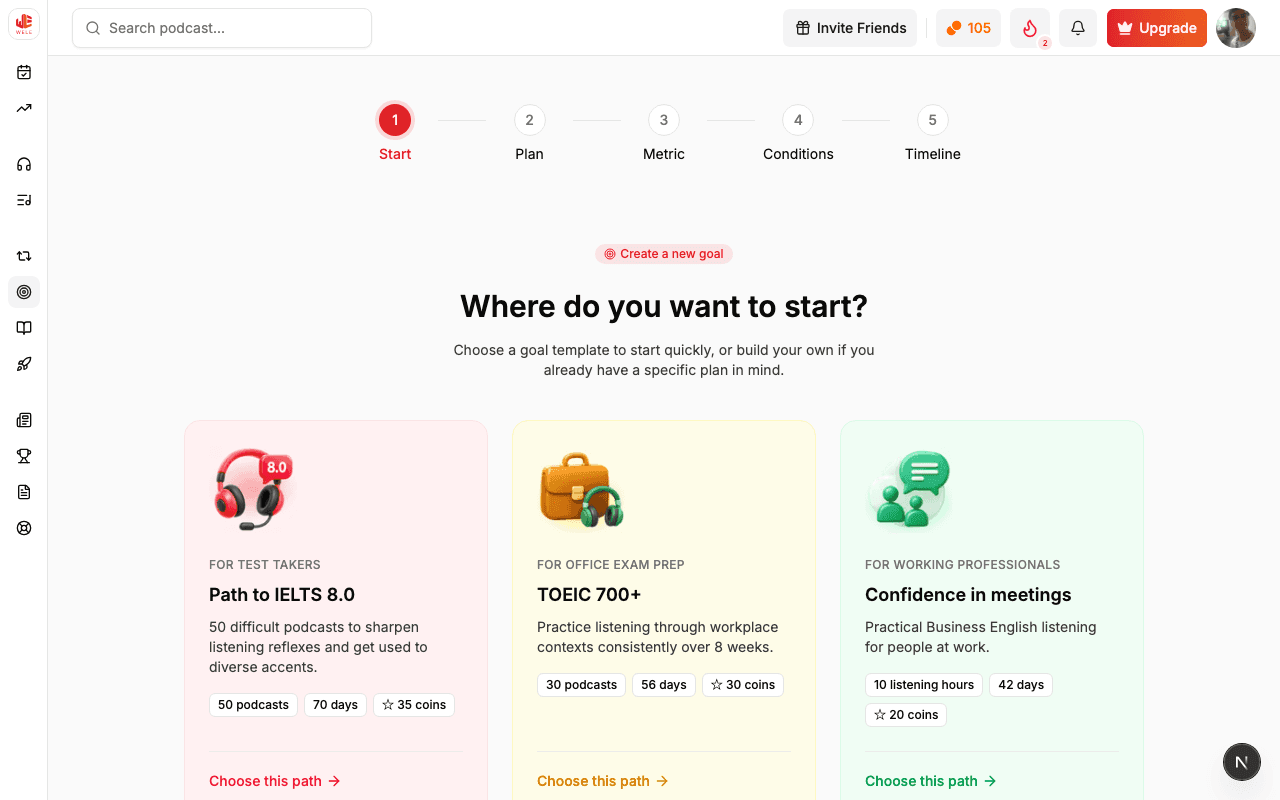
Choosing a goal
Click "New goal" to walk through a 5-step wizard (Start · Plan · Metrics · Conditions · Deadline). You can pick a ready-made template — Path to IELTS 8.0, TOEIC 700+, Confident in meetings, Ready to travel, Daily habit — or build your own from scratch with your own number of exercises, filters and deadline.
Free accounts have a few rules: only one active goal at a time, and every goal must have a deadline with a minimum duration. Why? A goal with no end point easily becomes an empty promise; requiring a deadline turns it into a real, measurable commitment. Premium users get these restrictions relaxed.
How goals tilt recommendations
WELE groups goals into types: conversation, travel, work, IELTS prep, TOEIC prep, academic, or general. The goal type you choose adds a gentle "tilt" to how exercises are ranked: an exercise's score is calculated as "level fit × (1 + up to 25% × goal relevance)". In other words, an exercise on your goal's topic gets a boost, but by at most about a quarter.
Why cap it at 25%? Because LEVEL FIT (difficulty close to your θ) still has to be the main factor. If goals tilted too strongly, you could get pushed toward exercises that are on topic but too hard or too easy — and an exercise at the wrong level doesn't teach you much, even if it's "on topic". The 25% cap is enough to steer you toward the right area, but not enough to drag you out of the desirable-difficulty zone of ~80% accuracy.
Another consequence of the cap: a goal NEVER starves you of variety. Even if you're aiming for IELTS, you still meet a wide range of topics at the right level, instead of being locked into a narrow groove of academic material — because listening widely is exactly what builds a good ear.
Did you know
- The goal tilt is capped: at most it raises an exercise's score by ~25%, so exercises are always around your level first, and on topic second.
- The 25% cap also keeps variety from being starved: even with a narrow goal, you still listen widely at the right level — because broad listening is what builds a good ear.
- WELE only adds the "for your goal X" label when an exercise is genuinely relevant — an exercise at the right level but off topic won't get a misleading label.
- On free accounts, goals must have a deadline and a minimum duration, and only one goal can be active at a time — so each goal is a measurable commitment, not an empty promise.