Vietnamese for caregivers: words, pronouns and short scenes for working with older adults
On this page
- Who is I and who is you: address terms first
- The words of a working day
- People, places and paperwork
- Personal care in the morning
- Meals and drinks
- Moving safely
- Memory, mood and activities
- Five patterns that carry most sentences
- 1. Address terms in every sentence
- 2. Politeness particles: dạ, vâng, ạ and nhé
- 3. Questions: có... không and đã... chưa
- 4. Gentle requests: mời, giúp and đi
- 5. Tones in the words that matter
- Three short scenes: the call bell, a hard lunch, a call from a son
- The call bell at night
- A hard lunch with Ông Hùng
- A phone call from the son
- Practising while your Vietnamese is still slow
- Questions learners ask
- Do I need perfect tones to work with Vietnamese residents?
- What do I do if I choose the wrong pronoun?
- Do I need to learn Northern or Southern Vietnamese?
- How is a carer different from a nurse in Vietnamese?
- How do I write care notes in Vietnamese?
- How do I speak to the family?
- One small thing to do tonight
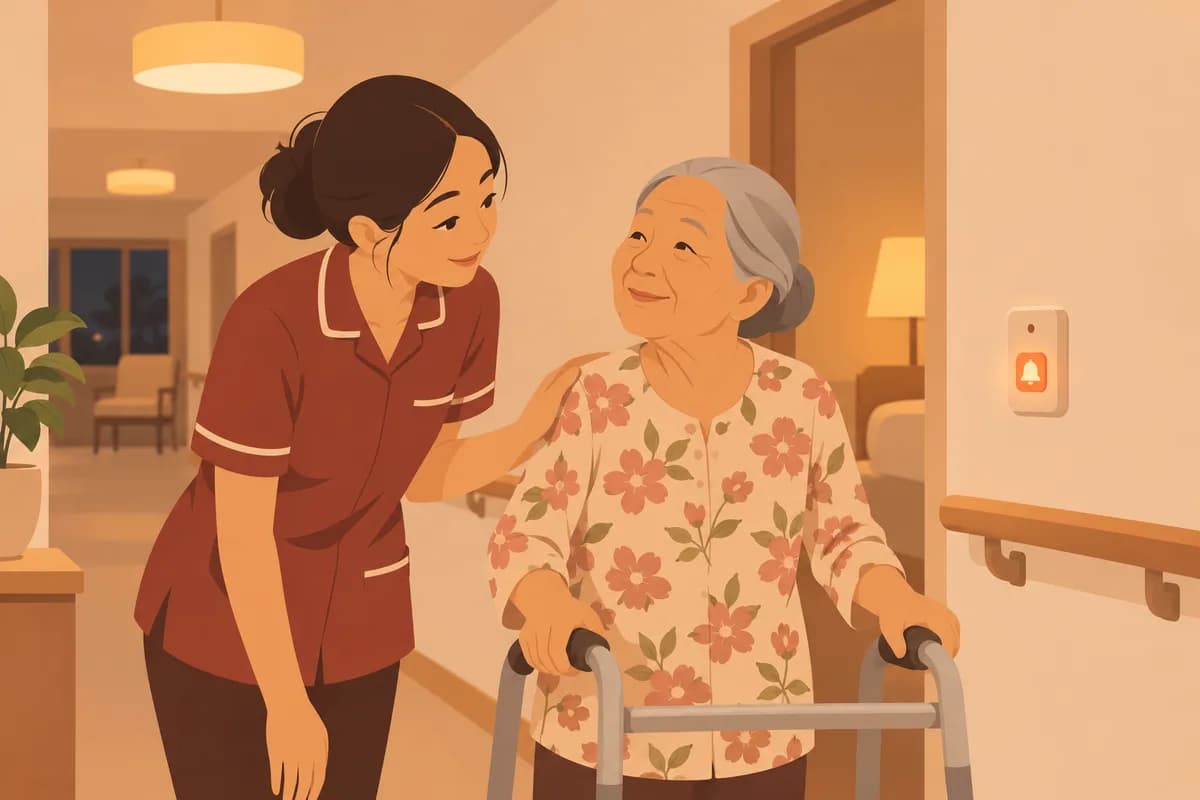
It is two in the morning in a residential aged care home in Sydney. A call bell rings, and a resident who speaks very little English says to you, the new night carer: 「Cháu ơi, bà muốn đi vệ sinh」. You know none of these words well, but you do notice that she called you cháu (grandchild) and herself bà (grandmother), not tôi and bạn. Those two small choices tell you more about the job than the toilet does.
Vietnamese care work runs on those choices. There is no single word for you in Vietnamese. Every sentence starts by deciding who is older, who is younger and how close you are, and the answer changes the pronoun, the particles at the end and the whole tone. Add six tones and a few regional differences, and it is easy to see why carers who learn only a list of nouns still feel lost on the first night shift.
This article is for people who care for Vietnamese-speaking older adults: staff in aged care homes in Australia, the United States, Canada and France, home carers, and foreign staff in Vietnam. The vocabulary follows a working day, with example sentences and translations. After that come five patterns that carry most of your sentences, three short scenes to read aloud and a practice plan. At the end there is a word set to play right away.
- Who is I and who is you: address terms first
- The words of a working day
- Five patterns that carry most sentences
- Three short scenes: the call bell, a hard lunch, a call from a son
- Practising while your Vietnamese is still slow
- Questions learners ask
- One small thing to do tonight
Who is I and who is you: address terms first
Vietnamese uses family words as pronouns. You pick a word for yourself and a word for the other person, based on age, not on how formal the situation is. For care work you will use a small set most of the time.
| The person you speak to | You call them | They call you, and you call yourself | Notes |
|---|---|---|---|
| An older woman, grandmother age | bà | cháu | Most common for a resident in their seventies or eighties. The resident may call herself bà when speaking to you. |
| An older man, grandfather age | ông | cháu | Same logic as bà. |
| Someone about your parents' age | cô (woman), chú (man) or bác | cháu | Bác is used for someone a little older than your parent, in the North more often. |
| Someone a few years older than you | chị (woman), anh (man) | em | Common between colleagues. |
| A very old person, formal | cụ | cháu | Respectful, used by some staff for the oldest residents. |
When you are not sure, ask. A carer can say 「Cháu nên gọi bà là gì ạ?」 (What should I call you, bà?) and the answer is usually warm. Notice that the family decides too: in the phone scene below, a son in his forties calls the young carer cháu and himself chú, because from the carer's side he is an uncle's age.
The words of a working day
Five tables follow a working day: people, places and paperwork; personal care in the morning; meals and drinks; moving safely; and memory, mood and activities. When a sentence is said to the resident, it uses plain words and a polite ạ at the end. The nouns in tables are the words used in notes and in talk with colleagues. Tones matter, so copy the diacritics exactly.
People, places and paperwork
| Word | Meaning | Example | English |
|---|---|---|---|
| người cao tuổi | older person, resident | Bà Lan là người cao tuổi nhất ở khu này. | Bà Lan is the oldest person on this floor. |
| người chăm sóc | caregiver | Cháu là người chăm sóc mới của bà ạ. | I am your new carer, bà. |
| viện dưỡng lão | care home | Viện dưỡng lão này có ba tầng và một khu vườn. | This care home has three floors and a garden. |
| chăm sóc tại nhà | home care | Buổi sáng cháu đi chăm sóc tại nhà ba nơi. | In the morning I do home care at three houses. |
| kế hoạch chăm sóc | care plan | Theo kế hoạch chăm sóc, bà thích uống trà ấm. | According to the care plan, she likes warm tea. |
| sổ theo dõi | care log, daily notes | Cháu ghi bà ăn gì vào sổ theo dõi. | I write what she ate in the care log. |
| chăm sóc ban ngày | day care | Thứ Ba và thứ Năm, ông đến trung tâm chăm sóc ban ngày. | On Tuesdays and Thursdays he goes to the day care centre. |
Người cao tuổi is the neutral written phrase for an older person, and you will see it on forms. In speech you almost always hear bà, ông, cụ or bác instead. The same logic applies to the phrase for care home: viện dưỡng lão is what people say, while on a sign you may also see trung tâm dưỡng lão.
Personal care in the morning
| Word | Meaning | Example | English |
|---|---|---|---|
| ga trải giường | bed sheet | Cháu thay ga trải giường cho bà nhé? | Shall I change your sheets, bà? |
| tắm rửa | bathing and washing | Hôm nay cháu giúp bà tắm rửa nhé. | Today I'll help you wash, bà. |
| đi vệ sinh | going to the toilet | Bà có muốn đi vệ sinh không ạ? | Would you like to go to the toilet, bà? |
| tã người lớn | adult diaper | Ban đêm ông dùng tã người lớn. | At night he uses an adult diaper. |
| thay tã | change a diaper | Cháu thay tã cho bà nhé. Bà nghiêng sang bên này giúp cháu ạ. | I'll change your diaper, bà. Please turn onto this side. |
| mặc quần áo | getting dressed | Cháu giúp bà mặc quần áo nhé. | I'll help you get dressed, bà. |
| vệ sinh răng miệng | mouth and teeth care | Ăn xong, cháu giúp ông vệ sinh răng miệng ạ. | After the meal I'll help you clean your mouth and teeth, ông. |
| răng giả | dentures | Tối nay bà tháo răng giả ra để cháu rửa nhé. | Tonight please take out your dentures so I can wash them. |
| riêng tư | privacy | Cháu đóng cửa lại để bà được riêng tư ạ. | I'll close the door so you have privacy, bà. |
A small point about tã. In the South you will hear tã, in the North bỉm is just as common for babies and adults. Both are fine, and carers use whichever the household uses. Remember that on the floor you say 「đi vệ sinh」 and 「thay tã」 gently, usually with an ạ at the end.
Meals and drinks
| Word | Meaning | Example | English |
|---|---|---|---|
| hỗ trợ ăn uống | help with eating | Cháu hỗ trợ ông ăn uống, ông cứ ăn từ từ. | I'll help you with your meal, ông, take your time. |
| đồ ăn xay nhuyễn | pureed food | Hôm nay bà ăn đồ ăn xay nhuyễn, có cháo và rau. | Today she has pureed food, with rice porridge and vegetables. |
| khó nuốt | difficulty swallowing | Ông bị khó nuốt nên nước uống phải làm đặc. | He has difficulty swallowing, so his drinks must be thickened. |
| sặc | choking on food or drink | Bà bị sặc khi ăn, cháu báo y tá ngay ạ. | She choked while eating, I'm telling the nurse right away. |
| uống đủ nước | drinking enough water | Trời nóng, bà nhớ uống đủ nước nhé. | It's hot, bà, please remember to drink enough water. |
| chán ăn | loss of appetite | Mấy hôm nay ông chán ăn, chỉ ăn được vài thìa. | These last few days he has had no appetite and eats only a few spoonfuls. |
The word chán has a wide meaning, from bored to fed up, and chán ăn means loss of appetite. When you write notes, use chán ăn for the fact and the person's own words for the reason. If a resident says 「Chán lắm」, it can mean they are bored, sad or just not hungry, so ask a gentle follow-up question.
Moving safely
| Word | Meaning | Example | English |
|---|---|---|---|
| chuyển người | moving a person, bed to chair | Hai cháu sẽ chuyển bà sang ghế, bà cứ thả lỏng người ạ. | Two of us will move you to the chair, bà, just relax. |
| khung tập đi | walking frame | Bà dùng khung tập đi thì đi vững hơn ạ. | You'll walk more steadily with the walking frame, bà. |
| máy nâng người | patient lift, hoist | Cháu dùng máy nâng người để đưa ông sang ghế. | I use the hoist to move you to the chair, ông. |
| thanh chắn giường | bed rail | Cháu chỉ kéo thanh chắn giường lên khi bà đồng ý ạ. | I only raise the bed rail when you agree, bà. |
| loét tì đè | pressure sore | Gót chân bà hơi đỏ, cháu báo y tá để phòng loét tì đè. | Your heel is a little red, bà, I'm telling the nurse to prevent a pressure sore. |
| ngã | fall, to fall down | Bà đi chậm thôi kẻo ngã ạ. | Walk slowly so you don't fall, bà. |
| phục hồi chức năng | rehabilitation exercises | Chiều nay bà tập phục hồi chức năng lúc hai giờ ạ. | This afternoon you have rehabilitation exercises at two, bà. |
Ngã means to fall, and it is also the name of a tone. In Northern speech it is a rising tone with a glottal break, and in Southern speech it sounds like ngả, the hỏi tone. When you are not sure, add context: 「bà bị ngã」 (she fell) cannot be mistaken.
Memory, mood and activities
| Word | Meaning | Example | English |
|---|---|---|---|
| sinh hoạt hằng ngày | daily living activities | Cháu ghi lại việc sinh hoạt hằng ngày của bà. | I record your daily living activities, bà. |
| sa sút trí tuệ | dementia | Bà bị sa sút trí tuệ nên cháu nói chậm và ngắn. | She has dementia, so I speak slowly and in short sentences. |
| suy giảm trí nhớ | memory decline | Gần đây ông suy giảm trí nhớ, hay quên giờ uống thuốc. | Lately his memory has declined and he often forgets his medicine times. |
| đi lang thang | wandering | Ban đêm ông hay đi lang thang nên cháu kiểm tra cửa. | At night he often wanders, so I check the doors. |
| kích động | agitated | Chiều tối bà dễ kích động, cháu bật nhạc nhẹ. | In the early evening she gets agitated easily, so I put on soft music. |
| già yếu | frail, weak with age | Bà đã già yếu, đứng dậy phải từ từ ạ. | You are frail now, bà, stand up slowly. |
| tự lập | independent, self-reliant | Việc gì bà tự làm được thì cháu để bà tự làm, cho bà tự lập. | What you can do yourself, bà, I let you do, so you stay independent. |
| hoạt động giải trí | recreational activity | Chiều nay có hoạt động giải trí, mình hát cùng nhau nhé. | This afternoon there is a recreational activity, let's sing together. |
| máy trợ thính | hearing aid | Cháu kiểm tra pin máy trợ thính cho bà ạ. | I'll check the battery of your hearing aid, bà. |
| giúp đỡ | to help | Bà cần gì cứ gọi, cháu sẽ giúp đỡ ạ. | Whatever you need, bà, just call and I'll help. |
| trấn an | to reassure | Cháu nói chuyện nhẹ nhàng để trấn an bà. | I speak gently to reassure you, bà. |
The word sa sút trí tuệ is the medical term for dementia, and families often prefer lú lẫn or the borrowed word Alzheimer when they talk at home. Staff use sa sút trí tuệ in writing and the family's words in conversation. Tự lập in care means keeping the person doing what they still can, which is also what the care plan records.
Five patterns that carry most sentences
1. Address terms in every sentence
A Vietnamese sentence to a resident usually starts or ends with the right pronoun. Instead of saying you, you repeat bà, ông, cô or chú, and for yourself you use cháu or em. A basic pattern: pronoun for the person, verb, ạ.
- Bà ngồi xuống đây ạ.
- Ông uống nước nhé.
- Cháu giúp bà đứng dậy nhé.
The typical mistake is to say bạn to an older person, because bạn means friend or equal and sounds disrespectful to an elder. The second mistake is tôi, which is correct but distant. In care, cháu for yourself is warmer.
2. Politeness particles: dạ, vâng, ạ and nhé
To answer an older person, begin with dạ (more common in the South) or vâng (more common in the North), and end sentences with ạ. When you suggest something, nhé or nha (more Southern) turns it into a gentle invitation. Older people reply to you with ừ, which is friendly and does not mean they are impolite.
- Dạ, cháu đến ngay ạ.
- Vâng, cháu hiểu rồi ạ.
- Bà uống thuốc nhé.
The typical mistake is to leave out ạ, which makes a sentence sound curt even if the words are polite. Another is to use dạ with someone younger than you, which is odd but not rude.
3. Questions: có... không and đã... chưa
A yes or no question wraps the verb: có + verb + không. For something that may already have happened, use đã + verb + chưa. Add ạ at the end to be polite.
- Bà có đau không ạ?
- Ông đã ăn sáng chưa ạ?
- Bà thấy trong người thế nào ạ?
Vietnamese does not answer with a plain yes or no. The reply repeats the verb: Có, đau (Yes, it hurts), Không đau (No, it doesn't hurt), Rồi (Already) or Chưa (Not yet). A learner who answers only vâng to 「Bà có đau không ạ?」 may be misunderstood. Listen for the verb in the reply and note it exactly.
4. Gentle requests: mời, giúp and đi
To ask the resident to do something, use mời (please, I invite you), giúp (help me by doing), or soften with đi and nhé at the end. A raw command sounds cold, and care speech is built to avoid that.
- Mời bà uống nước.
- Bà giơ tay lên giúp cháu nhé.
- Bà ngồi xuống đi ạ.
The typical mistake is to say 「Ngồi xuống」 or 「Giơ tay lên」 on their own. Those are commands you hear between friends or from a drill sergeant. Add the pronoun at the front and ạ or nhé at the end.
5. Tones in the words that matter
Vietnamese has six tones in the standard Northern pronunciation. The classic example is ma, má, mà, mả, mã, mạ, six different words. In care work the most important pair is ba and bà: ba means three or father, and bà means grandmother and is how you address an older woman. Say bà with a falling tone, and save ba for the number.
- bà (grandmother, you)
- ba (three, father)
- ngã (to fall)
In Southern speech the hỏi and ngã tones merge, so ngã and ngả can sound alike. You do not need to master this on your first day. Say the diacritics carefully when you write notes, and use context when you speak, as in 「bà bị ngã」.
Three short scenes: the call bell, a hard lunch, a call from a son
The three scenes use three different situations. Sam is the learner, and the residents are Bà Lan, Ông Hùng and a son called chú. Read both parts aloud, then cover the English column and say Sam's lines.
The call bell at night
| Speaker | Vietnamese | English |
|---|---|---|
| Bà Lan | Cháu ơi, bà muốn đi vệ sinh. | Dear, I want to go to the toilet. |
| Sam | Dạ, bà đợi cháu một chút ạ. Cháu lấy khung tập đi cho bà nhé. | Yes, please wait a moment, bà. I'll get your walking frame. |
| Bà Lan | Ừ, cảm ơn cháu. | Yes, thank you. |
| Sam | Bà nắm tay cháu, từ từ đứng dậy nha. Bà có chóng mặt không ạ? | Hold my hand and stand up slowly. Do you feel dizzy, bà? |
| Bà Lan | Không, bà ổn. | No, I'm fine. |
| Sam | Dạ. Cháu đứng ngoài cửa chờ bà. Xong bà gọi cháu nhé. | Good. I'll wait outside the door. When you're done, call me. |
Look at how Sam answers. Dạ, a short wait, a soft request with nhé, and a question that uses có... không. Sam also stays outside the door, which is the same respect for privacy you will see in care homes in many countries.
A hard lunch with Ông Hùng
| Speaker | Vietnamese | English |
|---|---|---|
| Sam | Ông ơi, đến giờ ăn trưa rồi ạ. Hôm nay có cháo gà. | Ông, it's lunchtime. Today there's chicken rice porridge. |
| Ông Hùng | Ông không muốn ăn. Chán lắm. | I don't want to eat. I'm fed up. |
| Sam | Dạ. Ông thử một thìa nhỏ thôi được không ạ? Cháo còn nóng, thơm lắm. | I see. Could you try just one small spoonful? The porridge is still hot and smells good. |
| Ông Hùng | Thôi được, một thìa thôi nhé. | All right, just one spoonful. |
| Sam | Ông ngồi thẳng lưng cho dễ nuốt nhé. Ông ăn từ từ, không vội ạ. | Sit up straight so it's easier to swallow. Eat slowly, no rush. |
| Ông Hùng | (ho) Sặc rồi. | (coughs) I choked. |
| Sam | Ông nghỉ một chút, uống một ngụm nước nhỏ ạ. | Rest a moment and take a small sip of water. |
Chán lắm is the kind of phrase a learner can misread. Sam does not argue and does not ask why. He accepts it with dạ and offers something small and warm. When Ông Hùng chokes, the answer is the same polite register: rest, a small sip. In a real care home Sam would also report the choking to the nurse.
A phone call from the son
| Speaker | Vietnamese | English |
|---|---|---|
| Chú (the son) | A lô, chú là con trai của bà Lan. Mẹ chú dạo này thế nào cháu? | Hello, I'm Bà Lan's son. How has my mother been lately? |
| Sam | Dạ, cháu chào chú. Cháu là Sam, người chăm sóc bà. Hôm nay bà ăn được nửa bát cháo và uống đủ nước ạ. | Hello, uncle. I'm Sam, her carer. Today she ate half a bowl of porridge and drank enough water. |
| Chú | Cảm ơn cháu. Dạo này mẹ chú hay quên lắm. | Thank you. These days my mother forgets a lot. |
| Sam | Dạ vâng, cháu sẽ báo với chị quản lý và ghi vào sổ theo dõi. Chú có muốn nói chuyện với bà không ạ? | Yes, I'll tell the manager and write it in the care log. Would you like to talk to her? |
| Chú | Có, cháu đưa điện thoại cho bà giúp chú nhé. | Yes, please hand the phone to her for me. |
This is where the pronouns do the heaviest work. The son calls his mother mẹ and says chú when he speaks to Sam, because to Sam he is an uncle's age. Sam calls the same woman bà, because to Sam she is a grandmother's age. Two people talk about one woman with two different words, and both are correct.
Practising while your Vietnamese is still slow
Start with the caregiving word set in Falling Stars or Pop It. Play until you can see a word and say its meaning, then go back to the tables and read each example aloud.
Listening comes next. Choose a recording in the Vietnamese podcasts, listen to one sentence at a time and write it down, then compare it with the transcript. Dictation shows you the tones your ear skips, especially the final ạ and nhé. For a guided path look at the courses, and use the vocabulary test to see where you stand. When you want a timed practice, the VPT mock test on WELE gives you one.
Outside WELE: the old FSI Vietnamese course materials are free to download, and several university Vietnamese programs publish tone drills. If you work in a care home with Vietnamese residents, ask a colleague to say the words in the table once, and record it on your phone. Your own recording from a working day is more useful than a published one.
Carers often study when they are tired, so short sessions are easier to keep than long ones. Fifteen minutes with one table beats a long weekend session. If you also want the neighbouring job, read Vietnamese for nurses, or see all Vietnamese by profession and the caregiving page.
Questions learners ask
Do I need perfect tones to work with Vietnamese residents?
No. Residents usually understand a carer with imperfect tones, especially when the sentence has context and the right pronoun. Still, learn the tones of the words you use most, like bà, ngã and sặc, because a wrong tone can change the word.
What do I do if I choose the wrong pronoun?
Most residents will correct you kindly or say nothing. If you get a reaction, ask 「Cháu nên gọi bà là gì ạ?」 and use the answer. Choosing too respectful a pronoun is safer than too casual.
Do I need to learn Northern or Southern Vietnamese?
Learn the one used where you work and listen to your residents. Both are mutually understood. The most visible differences for a carer are dạ and vâng, tã and bỉm, and the way hỏi and ngã tones sound.
How is a carer different from a nurse in Vietnamese?
The carer (người chăm sóc) helps with daily living: washing, eating, moving, dressing. The nurse (điều dưỡng) does medical work such as injections and drips under a doctor's orders. The nursing side has its own article, see Vietnamese for nurses.
How do I write care notes in Vietnamese?
Use short sentences, record the time and what you saw or heard, and quote the resident in quotation marks. Do not write opinions such as bà khó tính (she is difficult). Write what happened: bà không ăn cháo, nói chán.
How do I speak to the family?
Use the pronoun that fits their age relative to yours, add ạ, and report only what you observed. Leave medical explanations to the nurse. Say 「Cháu sẽ báo với chị quản lý」 when you are not sure it is your decision.
One small thing to do tonight
Pick one sentence from the scene with Bà Lan and say it aloud tonight with the right pronoun for someone in your own family, for example 「Bà đợi cháu một chút ạ」. Notice how it feels to say bà and cháu. After that, play one round of Falling Stars to see which words are still missing.
