Vietnamese for Nurses: Ward Vocabulary, Pronouns and Polite Phrases
On this page
- Who is at the bedside, and what to call them
- Người nhà: the family at the bedside
- Pronouns: you choose them by age
- Tones: six of them
- Particles: ạ, nhé, dạ and vâng
- Ward words, shift by shift
- Admission, the ward and handover
- Vital signs and symptoms
- Medication and procedures
- Bedside care and emergencies
- Five sentence patterns for the bedside
- 1. Polite requests: pronoun, verb, giúp em, nhé or ạ
- 2. Questions: có … không and đã … chưa
- 3. Time words: đã, đang, sẽ
- 4. Counting and doses: classifiers
- 5. Bị, and saying where it hurts
- Two conversations: bed 9 and the handover
- A bedside check with the daughter present
- A handover that starts with the bed number
- Practice before and during a placement
- Questions from foreign nurses and volunteers
- Who looks after the patient in a Vietnamese ward, the nurses or the relatives?
- How do I address a patient and the relatives politely?
- Do nurses in Vietnam speak English?
- What should I ask the ward manager before my first shift?
- Can I use a translation app with patients?
- Before your first morning on the ward
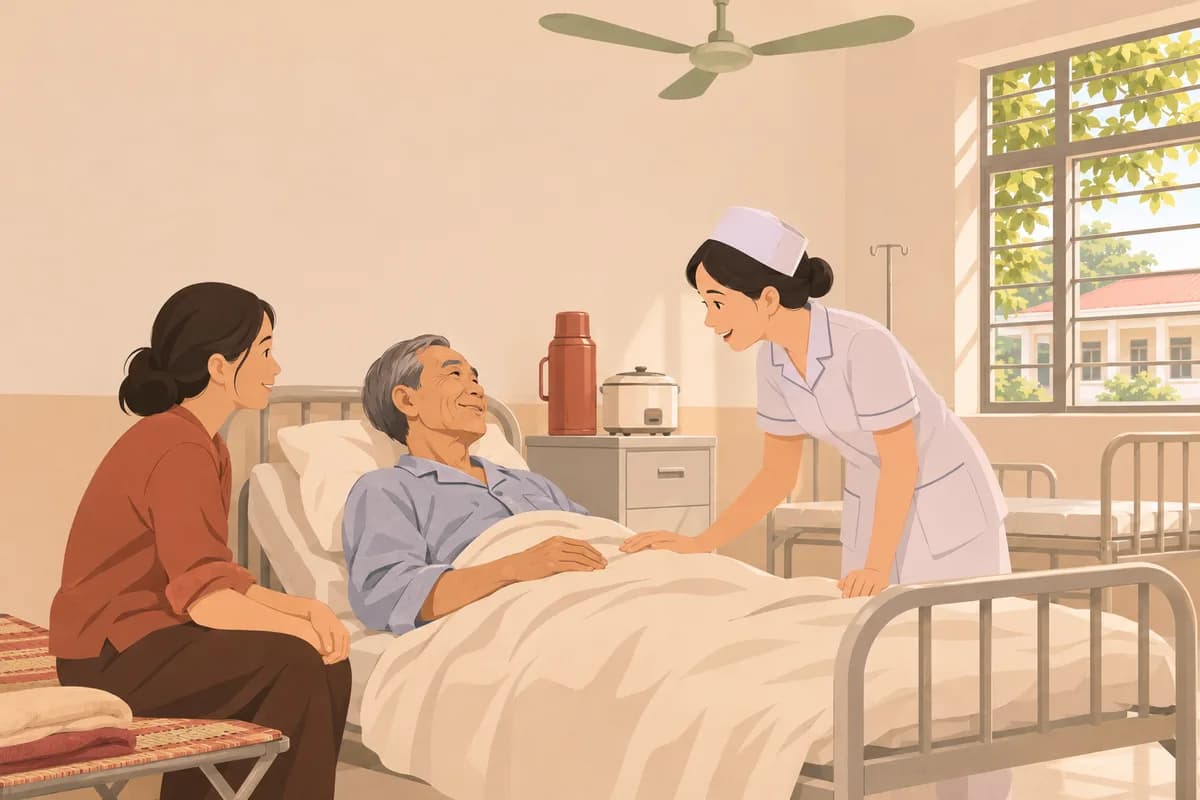
On a week-long medical mission at a provincial hospital in Vietnam, you notice that the corridors are lined with folding beds, thermoses and small rice cookers. Almost every patient has a relative staying beside them, day and night. In bed nine, a woman stands up as you pass and says, 「Cô ơi, ba em tối qua sốt, chân đau lắm.」 You catch sốt and đau, so you know it is fever and pain. What you might miss is that she called you cô, called her father ba, and that your reply depends on those small words.
Two things set a Vietnamese ward apart. First, người nhà, the family member who stays, helps with feeding and washing, and is often the person you actually talk to. Second, every conversation begins with choosing pronouns by age, while six tones and small particles such as ạ and nhé carry the meaning and the politeness. Grammar is the lighter part, since verbs do not conjugate and there are no articles.
This article is for nurses, medics and carers who work with Vietnamese-speaking patients: foreign staff in Vietnam, volunteers on medical missions, and nurses of Vietnamese heritage whose patients speak Vietnamese at the bedside. You get ward vocabulary by situation, a guide to pronouns, five grammar points, two model dialogues and a practice plan.
- Who is at the bedside, and what to call them
- Ward words, shift by shift
- Five sentence patterns for the bedside
- Two conversations: bed 9 and the handover
- Practice before and during a placement
- Questions from foreign nurses and volunteers
- Before your first morning on the ward
Who is at the bedside, and what to call them
Người nhà: the family at the bedside
In many Vietnamese public hospitals a relative stays with the patient around the clock. People call this person người nhà (family member) or người nuôi bệnh (the one who looks after the patient). They bring meals, help with washing and toileting, and often answer for the patient, especially when the patient is old or tired. As a nurse you will speak to them as often as to the patient, and sometimes more often.
The pronouns can look tangled at first, because each person uses their own family words. The daughter says ba (father) for the patient, calls you cô, and calls herself em or con. You call the patient bác, ông or bà, call her chị, and call yourself em. Which relative may be told what is set by each hospital, so ask the nurse in charge (điều dưỡng trưởng) before you discuss a diagnosis with anyone.
Pronouns: you choose them by age
Vietnamese uses family words as pronouns. You pick one for the patient and one for yourself based on who is older and by how much. The table shows common patterns on the ward, but treat them as patterns that shift a little between the north and the south.
| Patient | Call them | Call yourself |
|---|---|---|
| Elderly woman, grandmother age | bà | cháu or con |
| Elderly man, grandfather age | ông | cháu or con |
| Woman around your parents’ age | cô, or bác if she is older | em, cháu or con |
| Man around your parents’ age | chú, or bác if he is older | em, cháu or con |
| Adult a few years older than you | anh (man), chị (woman) | em |
| Younger adult | em | anh or chị |
Vietnamese nurses often say em for themselves with patients who look somewhat older, and cháu or con with much older patients. As a foreign speaker you can fall back on tôi, a neutral “I”, and still call the patient by the right family word. Avoid bạn with an older patient, since it is a word for peers.
Tones: six of them
Every syllable has a tone, written with a mark. A wrong tone gives you a different word, so treat the tone as part of the spelling and learn it together with the word, from the first day.
| Tone | Mark | Rough sound | Words from the ward |
|---|---|---|---|
| level (ngang) | none | flat, mid pitch | tay hand, đau pain |
| falling (huyền) | à (grave accent) | low, drifting down | người nhà family, gầy thin |
| rising (sắc) | á (acute accent) | rising | thuốc medicine, sốt fever |
| asking (hỏi) | ả (hook above) | dips, then lifts gently | thở to breathe, khỏe well |
| creaky (ngã) | ã (tilde) | rising with a break in many northern accents | mũi nose, ngã to fall |
| heavy (nặng) | ạ (dot below) | low and short | bệnh illness, mạch pulse |
In many southern accents hỏi and ngã sound alike, so you will not always hear the difference. A classic trap is đau (pain) against đâu (where). Together they make the most useful question on the ward: Đau ở đâu? Where does it hurt?
Particles: ạ, nhé, dạ and vâng
Ạ added at the end of a sentence shows respect to an older person. Nhé softens a request or announcement, close to “okay?” or “all right?”. For “yes” in a polite reply, northerners say vâng and southerners say dạ. Both also work as a respectful “I am listening”.
Ward words, shift by shift
The four tables run from the morning handover to care at the bedside. Examples use em for the nurse and bác for the patient, so if you are older than the patient, swap in the pronouns from the table above. All 42 words of the practice set appear here, together with a few extras such as phòng bệnh, chuông gọi and loét tì đè.
Admission, the ward and handover
| Word | Meaning | Example | English |
|---|---|---|---|
| bệnh nhân | patient | Bệnh nhân ở giường số 9 mới vào viện đêm qua. | The patient in bed nine came in last night. |
| điều dưỡng | nurse | Em là điều dưỡng phụ trách của bác hôm nay. | I am your nurse today. |
| bác sĩ | doctor | Bác sĩ sẽ đến khám ngay. | The doctor will come to examine you shortly. |
| khoa | hospital ward (department) | Khoa Ngoại ở tầng 6. | The surgical ward is on the sixth floor. |
| phòng bệnh | patient room | Phòng bệnh số năm ở cuối hành lang. | Room five is at the end of the corridor. |
| ca trực | work shift | Tuần này em trực đêm ba lần. | This week I am on night duty three times. |
| bàn giao ca | shift handover | Bàn giao ca sáng bắt đầu lúc 6 giờ 45. | Morning handover starts at 6:45. |
| nhập viện | hospital admission (admission to hospital) | Bác Tư nhập viện sáng nay. | Mr Tư was admitted this morning. |
| xuất viện | hospital discharge (leaving hospital) | Ngày mai bác có thể xuất viện. | You can leave hospital tomorrow. |
| người nhà | next of kin (family member at the bedside) | Người nhà vui lòng chờ bên ngoài. | Family members, please wait outside. |
| bệnh án | medical record | Em ghi vào bệnh án nhé. | I will note it in the medical record. |
| chuông gọi | call bell | Cần gì bác bấm chuông gọi nhé. | Press the call bell if you need anything. |
The word bàn giao ca means handover, and in a Vietnamese ward the report often refers to patients by bed number, as in giường số 12. Listen for numbers early in each report, because they tell you who is being discussed.
Vital signs and symptoms
| Word | Meaning | Example | English |
|---|---|---|---|
| huyết áp | blood pressure | Em đo huyết áp cho bác nhé. | Let me take your blood pressure. |
| mạch | pulse | Mạch của bác hơi nhanh. | Your pulse is a little fast. |
| thân nhiệt | body temperature | Thân nhiệt của bác là ba mươi bảy độ hai. | Your temperature is 37.2 degrees. |
| nhiệt kế | thermometer | Bác kẹp nhiệt kế vào nách giúp em. | Please put the thermometer under your arm. |
| sinh hiệu | vital signs | Em kiểm tra sinh hiệu cho bác nhé. | I will check your vital signs. |
| sốt | fever | Bác bị sốt từ khi nào ạ? | Since when have you had a fever? |
| đau | to hurt, in pain | Bác đau ở đâu ạ? | Where does it hurt? |
| cơn đau | pain, a bout of pain | Bác chấm cơn đau mấy điểm, từ không đến mười ạ? | How would you rate the pain from zero to ten? |
| chóng mặt | dizziness | Bác có bị chóng mặt không ạ? | Are you feeling dizzy? |
| buồn nôn | nausea | Bác có buồn nôn không ạ? | Do you feel nauseous? |
| triệu chứng | symptom | Những triệu chứng này bắt đầu từ khi nào ạ? | When did these symptoms start? |
| dị ứng | allergy | Bác có dị ứng thuốc nào không ạ? | Are you allergic to any medicine? |
| ống nghe | stethoscope | Em dùng ống nghe để nghe phổi của bác nhé. | I will listen to your lungs with the stethoscope. |
Patients often describe feelings rather than medical words, such as tức ngực (tightness in the chest) or mệt (tired). When an answer is unclear, ask a second, narrower question before you write it down.
Medication and procedures
| Word | Meaning | Example | English |
|---|---|---|---|
| thuốc | medication (medicine) | Bác uống thuốc này sau khi ăn nhé. | Please take this medicine after eating. |
| liều dùng | dose | Hai người cùng kiểm tra liều dùng. | Two people check the dose together. |
| y lệnh | doctor's orders | Em làm theo y lệnh của bác sĩ. | I follow the doctor’s orders. |
| cho dùng thuốc | to administer (give medication) | Em cho bác dùng thuốc đúng giờ. | I give you the medicine on time. |
| mũi tiêm | injection | Em tiêm cho bác nhé, sẽ hơi nhói một chút. | I will give you the injection, it will sting a little. |
| ống tiêm | syringe | Em dùng ống tiêm vô khuẩn. | I use a sterile syringe. |
| truyền dịch | IV drip, to infuse fluids | Truyền dịch mất khoảng hai tiếng. | The IV drip takes about two hours. |
| lấy máu | blood draw | Sáng mai em lấy máu cho bác nhé. | I will take your blood tomorrow morning. |
| vô khuẩn | sterile | Đây là dụng cụ vô khuẩn. | This is a sterile instrument. |
| vệ sinh tay | hand hygiene | Em vệ sinh tay trước khi làm thủ thuật. | I clean my hands before the procedure. |
| nhịn ăn uống | nil by mouth (no food or drink) | Bác nhịn ăn uống từ 10 giờ đêm nay vì mai nội soi nhé. | Please take nothing by mouth from 10 tonight, because of tomorrow’s endoscopy. |
| oxy | oxygen | Em cho bác thở oxy 2 lít/phút. | I am giving you oxygen, 2 litres a minute. |
Doses are spoken with classifiers and a frequency, for example hai viên, hai lần một ngày, sau khi ăn (two tablets, twice a day, after eating). The grammar section below explains the pattern. Say it aloud and let a colleague check it when safety depends on it.
Two small notes. Y lệnh is the ward word for what the doctor has ordered for a patient, and care follows it. Đơn thuốc, the prescription slip, is what an outpatient or a patient going home receives. And nội soi, endoscopy, is a common reason for being told to take nothing by mouth.
Bedside care and emergencies
| Word | Meaning | Example | English |
|---|---|---|---|
| vết thương | wound | Em xem vết thương của bác một chút nhé. | Let me look at your wound for a moment. |
| băng gạc | wound dressing (gauze) | Em thay băng gạc cho bác nhé. | I will change your dressing. |
| xoay trở | to reposition a patient (turn) | Hai tiếng em xoay trở cho bác một lần. | I turn you every two hours. |
| nằm liệt giường | bedridden | Bà nằm liệt giường từ sau ca mổ. | She has been bedridden since the operation. |
| loét tì đè | pressure sore | Em phòng ngừa loét tì đè cho bác. | I am working to prevent pressure sores. |
| xe lăn | wheelchair | Em đỡ bác ngồi lên xe lăn nhé. | Let me help you into the wheelchair. |
| cáng | stretcher | Em đưa bác đi chụp X-quang bằng cáng. | I will take you for the X-ray on a stretcher. |
| ngã | to fall | Bác cẩn thận kẻo ngã nhé. | Be careful not to fall. |
| theo dõi | to monitor | Em sẽ theo dõi huyết áp của bác cả ngày. | I will monitor your blood pressure all day. |
| hít thở sâu | breathe deeply | Bác hít thở sâu giúp em nhé. | Please take a deep breath. |
| nằm xuống | lie down | Bác nằm xuống giúp em nhé. | Please lie down. |
| cấp cứu | emergency | Đây là ca cấp cứu, em báo bác sĩ ngay. | This is an emergency, I am calling the doctor now. |
| phẫu thuật | surgery | Ca phẫu thuật bắt đầu lúc chín giờ sáng mai. | The surgery starts at nine tomorrow morning. |
The last two rows of the table, cấp cứu and phẫu thuật, are the ones you will hear when something changes fast. Learn to recognise them even when you cannot yet say the whole sentence.
Five sentence patterns for the bedside
1. Polite requests: pronoun, verb, giúp em, nhé or ạ
The frame for asking a patient to do something is pronoun, verb, giúp em, then nhé or ạ. Giúp em means “for me, please” and nhé makes it gentle.
- Bác nằm xuống giúp em nhé.
- Chị chờ một chút ạ.
- Anh xắn tay áo lên giúp em nhé.
The usual learner mistake is to say 「Bạn nằm xuống」 with tôi as the speaker. It is grammatical, but it sounds flat and blunt to an older person. Use the family word for the patient and add nhé or ạ.
2. Questions: có … không and đã … chưa
For yes or no questions about a state, use có … không. For something that should have happened by now, use đã … chưa. The answers are có or không for the first, and rồi (already) or chưa (not yet) for the second.
- Bác có đau không ạ?
- Bác đã uống thuốc chưa ạ?
- Chị có dị ứng thuốc nào không ạ?
The common mistake is to answer or write không when the patient means chưa. 「Chưa」 means not yet, and the medicine may still be due. 「Không」 means no, and the patient may be refusing. On a ward those two answers lead to different actions.
3. Time words: đã, đang, sẽ
Vietnamese verbs do not change form. When you need to make time clear, put đã (done), đang (in progress) or sẽ (will) before the verb. Often the context already says it and you can leave the marker out.
- Em sẽ đo huyết áp cho bác.
- Bác đang truyền dịch.
- Bác đã ăn sáng chưa ạ?
Learners sometimes put đã in every sentence because it feels like a past tense. A sentence like 「Em đã đo huyết áp」 is fine when you want to stress that it is done, but ordinary reports sound more natural without it.
4. Counting and doses: classifiers
Numbers need a classifier before the noun. Tablets use viên, a bag or bottle of fluid uses chai or túi, and times a day use lần. The frame for a dose is number plus classifier plus noun, then frequency, then timing.
- Bác uống hai viên thuốc, hai lần một ngày.
- Mỗi lần một viên, sau khi ăn.
- Một chai dịch truyền chạy khoảng một tiếng.
The usual mistake is to say 「hai thuốc」 without a classifier, which sounds incomplete.
5. Bị, and saying where it hurts
For unpleasant conditions, Vietnamese uses bị before the symptom: bị sốt, bị đau, bị ho, bị dị ứng. To say where, use đau followed by the body part, and ở đây means “here”.
- Bác bị sốt từ khi nào ạ?
- Bác đau ở đâu? Ở đây ạ?
- Bác bị đau bụng bao lâu rồi ạ?
English speakers often reach for là, as in 「Bác là sốt」, because “be” feels necessary. Vietnamese does not use là with symptoms. Use bị or just the symptom word, and ask từ khi nào (since when) or bao lâu rồi (how long now) to place it in time.
Two conversations: bed 9 and the handover
A bedside check with the daughter present
Anna, a foreign nurse on a surgical ward, checks Mr Tư in bed 9. His daughter sits on the folding bed beside him. Read all three parts aloud, and notice who calls whom what.
| Speaker | Vietnamese | English |
|---|---|---|
| Nurse | Chào bác Tư, em là Anna, điều dưỡng chăm sóc bác hôm nay ạ. | Hello Mr Tư, I am Anna, your nurse today. |
| Patient | Chào cô. | Hello, miss. |
| Nurse | Em đo thân nhiệt và huyết áp cho bác nhé. Bác đưa tay cho em ạ. | I will take your temperature and blood pressure. Please give me your arm. |
| Daughter | Ba em ngủ không được, cô ơi. Tối qua ba sốt, vết thương ở chân cũng đau nhiều. | My father could not sleep, miss. He had a fever last night and the wound on his foot hurts a lot. |
| Nurse | Dạ, chị cho em xem vết thương một chút nhé. Bác đau nhiều không ạ? | Yes, please let me look at the wound for a moment. Does it hurt a lot? |
| Patient | Đau lắm, nhất là lúc thay băng. | A lot, especially when the dressing is changed. |
| Nurse | Thân nhiệt của bác là 37,8 độ. Em báo bác sĩ ngay, rồi em thay băng gạc cho bác ạ. | Your temperature is 37.8. I will tell the doctor straight away, then I will change your dressing. |
| Daughter | Cô ơi, tối nay ba có được ăn cơm không? | Miss, can he eat dinner tonight? |
| Nurse | Em xem y lệnh nhé. Theo y lệnh, bác nhịn ăn uống từ 10 giờ đêm vì sáng mai làm sạch vết thương. Chị nhớ nhắc bác giúp em, cần gì chị bấm chuông gọi nhé. | Let me check the doctor’s orders. According to them, he takes nothing by mouth from 10 tonight because the wound is being cleaned tomorrow morning. Please remind him for me, and press the call bell if you need anything. |
A handover that starts with the bed number
A Vietnamese handover usually opens with the bed number and the diagnosis, then what happened, the orders in force and what the family has been told. Listen once, then read it back phrase by phrase.
| Part | Vietnamese | English |
|---|---|---|
| Bed and diagnosis | Giường số 9, bác Tư, 67 tuổi, đái tháo đường, vết thương bàn chân phải, ngày thứ 5 điều trị. | Bed 9, Mr Tư, 67 years old, diabetes, a wound on the right foot, fifth day of treatment. |
| What happened | Sáng nay bác sốt 37,8 độ, đau nhiều khi thay băng. Đã báo bác sĩ. | This morning he had a temperature of 37.8 and a lot of pain when the dressing was changed. The doctor has been told. |
| Orders | Theo y lệnh, bác nhịn ăn uống từ 22 giờ, sáng mai làm sạch vết thương. | Under the orders, he takes nothing by mouth from 22:00, and the wound is cleaned tomorrow morning. |
| Family | Con gái ở lại nuôi bệnh. Đã dặn chị nhắc bác không ăn uống sau 22 giờ. | His daughter is staying to look after him. She has been asked to remind him not to eat or drink after 22:00. |
Practice before and during a placement
Start with the nursing set in Falling Stars or Pop It. Play until you can match each word to its meaning, then go back to the tables and read each example aloud, paying attention to the tone marks.
Listening is the harder half, and relatives speak quickly. Pick an episode from the Vietnamese podcasts, write down one sentence at a time and compare with the transcript. Writing it down shows you which tones and small words your ear skips. If you want a path, look at the courses, and use the vocabulary test to see where you start. When you want a benchmark, the Vietnamese mock test gives you one.
Outside WELE, VietnamesePod101 and the YouTube channel Learn Vietnamese with Annie both give short, well-paced lessons. Neither is about nursing, so the ward words still come from this article and from colleagues. Keep in mind that bedside Vietnamese is for routine care. For consent, medication counselling or a complex history, use a qualified interpreter, and do not rely on your own level or on a translation app. If you want the wider picture, see the nursing page or all professions.
On a short mission there is little time for study, so work in small pieces: a round of the game on the way to the ward, a few sentences written down after the shift.
Questions from foreign nurses and volunteers
Who looks after the patient in a Vietnamese ward, the nurses or the relatives?
Both, and the split depends on the hospital. In many public hospitals a relative handles daily care such as feeding, washing and keeping the patient company, while nurses give treatment, monitor the patient and follow the doctor’s orders. Ask the nurse in charge how it works on your ward.
How do I address a patient and the relatives politely?
Use a family word that matches their age: bà, ông, cô, chú, bác, anh, chị or em. Add ạ at the end of questions to an older person. If you are unsure, anh or chị with tôi is a safe starting point for a foreigner, and you can listen to what the relatives call each other and follow that.
Do nurses in Vietnam speak English?
Some do, especially in international hospitals and among younger staff. In public hospitals and outside the big cities you should expect much less English. Learn the basics for your own safety and for your patients’ comfort.
What should I ask the ward manager before my first shift?
Ask which tasks you may do, which relatives may be told what, how the handover is given (by bed number, in which order), and who to call when you need an interpreter. Those four answers cover most of the uncertainty on a first day.
Can I use a translation app with patients?
For simple prompts such as a greeting or asking someone to sit, it can help, but check it against what you know. For medication, consent or anything where a mistake has consequences, use a qualified interpreter and your hospital’s process instead.
Before your first morning on the ward
If your placement date is set, play one round of the set in Falling Stars first, so that người nhà, y lệnh and nhịn ăn uống are not new words when you hear them at bed nine.
