Vietnamese for Cabin Crew and Ground Staff: Vocabulary, Polite Forms and Dialogues
On this page
- How a shift sounds in Vietnamese
- Pronouns: you choose them by age and context
- Tones: three pairs that matter at work
- Vocabulary by stage of the journey
- The counter and baggage
- The gate and disruption
- In the cabin: safety
- Service and announcements
- Five grammar points for the cabin and the counter
- 1. Xin, vui lòng and làm ơn: three ways to ask
- 2. Dạ, vâng and ạ: the particles that carry politeness
- 3. Sẽ, đang, đã, vừa and sắp: time without conjugation
- 4. Numbers and classifiers: rows, gates, pieces
- 5. Giving bad news: rất tiếc, xin lỗi and giải pháp
- Three dialogues and a boarding announcement
- At the counter before Tet
- A first-time flyer and the seat belt
- A delay because of a storm at the gate
- Sample boarding announcement
- The interview in Vietnamese
- Practise between flights
- Frequently asked questions
- Do I need Vietnamese to work for a Vietnamese airline?
- Should I learn the northern or the southern accent?
- Can I call passengers bạn?
- What is the difference between ground staff and cabin crew in Vietnamese?
- What do I say if I do not understand a passenger?
- One thing to do today
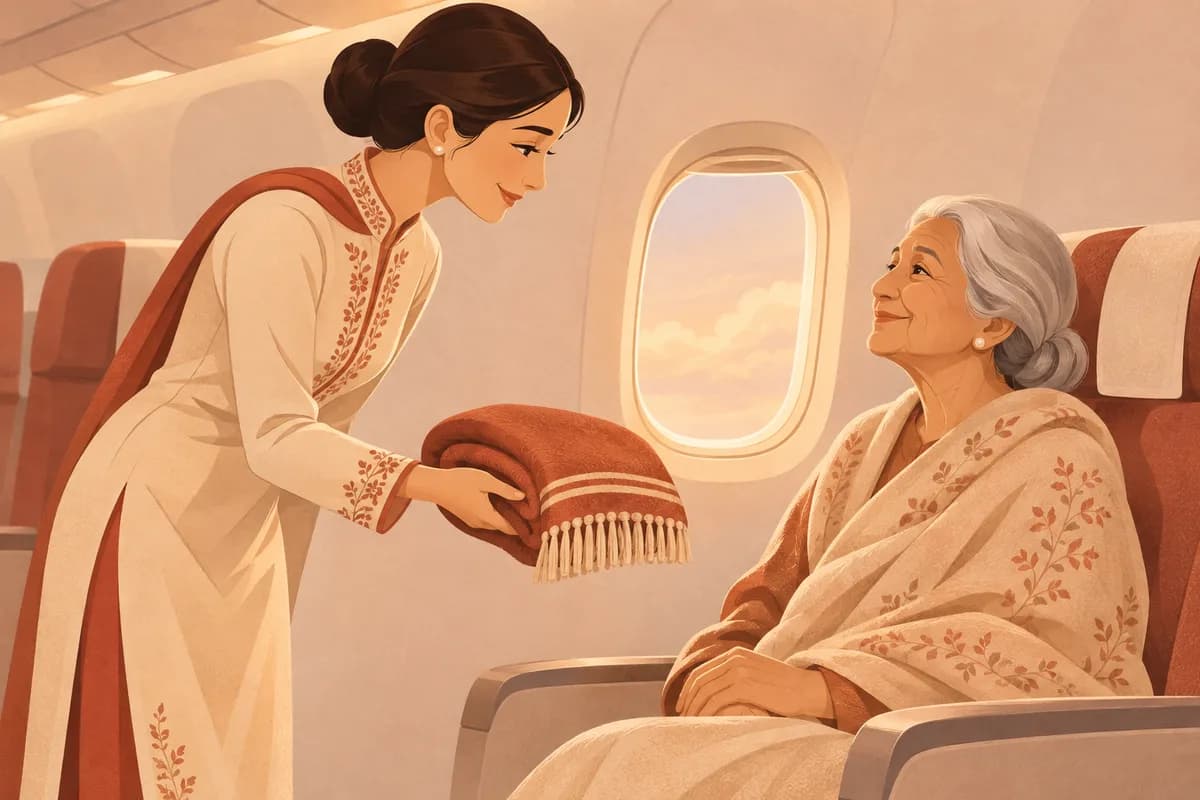
An elderly woman in seat 9A beckons you over during a domestic flight from Hanoi to Da Nang and says, 「Cháu ơi, cho bà cái chăn.」 You catch chăn, so you know she wants a blanket. What you might miss is that she has called you cháu (grandchild) and herself bà (grandmother), and that your reply depends on those two small words.
Vietnamese helps you in one way. It has no conjugation and no articles, so a sentence like Máy bay sắp cất cánh stays the same for every speaker and every tense you are likely to need. The difficulty is elsewhere. You must choose how to address each passenger, six tones change the meaning of words you already know, and tiny particles such as ạ and dạ carry most of the politeness.
This article is for flight attendants, ground agents and airline staff of Vietnamese heritage who work with Vietnamese-speaking passengers, and for foreign crew on routes to and from Vietnam. You get vocabulary by stage of the journey, a guide to pronouns, five grammar points, a short tone drill, three dialogues, interview questions and a practice plan.
- How a shift sounds in Vietnamese
- Vocabulary by stage of the journey
- Five grammar points for the cabin and the counter
- Three dialogues and a boarding announcement
- The interview in Vietnamese
- Practise between flights
- Frequently asked questions
How a shift sounds in Vietnamese
Pronouns: you choose them by age and context
Vietnamese uses family words as pronouns, so before you speak you pick one for the passenger and one for yourself. On a plane, the safest choice for an unknown adult is quý khách, which means roughly “honoured guest” and is used in every announcement. For a single passenger you can add a family word as soon as you can judge age.
| Passenger | Call them | Call yourself | Example |
|---|---|---|---|
| Any adult, unknown age | quý khách | tôi (neutral) or em (younger crew member) | Quý khách cần gì ạ? |
| Elderly woman | bà | cháu or con | Bà dùng nước hay trà ạ? |
| Elderly man | ông | cháu or con | Ông ngồi ghế này được không ạ? |
| Woman around your parents’ age | cô, or bác if she is older | cháu or em | Cô cần thêm chăn không ạ? |
| Man around your parents’ age | chú, or bác if he is older | cháu or em | Chú đừng lo, em hỗ trợ ngay ạ. |
| Adult close to your age | anh (man) or chị (woman) | em | Chị để túi ở đây giúp em nhé. |
Vietnamese crew often say em for themselves with passengers who look older, and cháu with much older passengers. If you are a foreign speaker, tôi plus the right family word for the passenger is a good safe pair. Avoid bạn with an adult passenger, because it is a word for peers.
Tones: three pairs that matter at work
Every syllable has a tone, and a wrong tone gives a different word. Treat the tone mark as part of the spelling. The pairs below come up in real airport sentences, and you should say each aloud with a recording to compare.
| Pair | Meaning | Where you meet it |
|---|---|---|
| bay and bảy | fly, and seven | máy bay, cửa số bảy |
| hoãn and hoàn | postpone, and complete or refund | hoãn chuyến (delay), hoàn tiền (refund) |
| đến and đền | arrive, and compensate | đến nơi (arrive), đền bù (compensation) |
The pair hoãn and hoàn is worth special attention. A passenger who hears hoàn where you meant hoãn may think of hoàn tiền, a refund, and not a delay. Practise the two until the low falling tone of hoàn and the creaky rising tone of hoãn feel different in your mouth.
Vocabulary by stage of the journey
The four tables follow a flight: the counter, the gate, the cabin, and then service and announcements. The 42 words of the game at the end fit inside them, with a few extras such as nhân viên mặt đất (ground staff), an ninh (security) and chăn (blanket).
The counter and baggage
| Vietnamese | Meaning | Example | Translation |
|---|---|---|---|
| làm thủ tục | to check in | Quý khách làm thủ tục ở quầy số sáu ạ. | Please check in at counter six. |
| thẻ lên máy bay | boarding pass | Cho tôi xin hộ chiếu và thẻ lên máy bay của quý khách. | May I have your passport and boarding pass. |
| hành khách | passenger | Hành khách đã lên đủ rồi chị. | All passengers are on board. (said to a colleague, not to a passenger) |
| chuyến bay | flight | Chuyến bay của quý khách khởi hành lúc mười giờ hai mươi. | Your flight leaves at 10:20. |
| hành lý | baggage | Quý khách gửi mấy kiện hành lý ạ? | How many pieces of baggage are you checking in? |
| hành lý xách tay | carry-on | Túi này quý khách mang lên máy bay được ạ. | You can take this bag on the plane. |
| hành lý quá cước | excess baggage | Hành lý của quý khách bị quá cước nên phải trả thêm phí. | Your baggage is over the limit, so there is an extra fee. |
| khu nhận hành lý | baggage claim | Hành lý sẽ có ở khu nhận hành lý, băng chuyền số ba. | Your bags will be at baggage claim, belt three. |
| thất lạc hành lý | lost baggage | Tôi sẽ làm biên bản thất lạc hành lý cho quý khách. | I will file a lost baggage report for you. |
| xuất nhập cảnh | immigration | Sau khi qua khâu xuất nhập cảnh, quý khách đi theo biển chỉ dẫn. | After immigration, please follow the signs. |
Notice that hành lý works for any amount, like the English “baggage”. To count, you add a classifier such as kiện (piece) or túi (bag): hai kiện hành lý, ba túi xách tay. Grammar point five covers this in more detail.
The gate and disruption
| Vietnamese | Meaning | Example | Translation |
|---|---|---|---|
| cửa ra máy bay | gate | Cửa ra máy bay của quý khách là cửa số bảy. | Your gate is gate seven. |
| lên máy bay | to board | Mời quý khách lên máy bay. | Please board the plane. |
| máy bay | aircraft | Máy bay đang được vệ sinh. | The aircraft is being cleaned. |
| nối chuyến | connecting flight | Quý khách nối chuyến đi Đà Nẵng lúc mười bốn giờ. | Your connecting flight to Da Nang is at 14:00. |
| chậm chuyến | delay | Chuyến bay chậm khoảng ba mươi lăm phút vì thời tiết xấu. | The flight is delayed by about thirty-five minutes because of bad weather. |
| hủy chuyến | cancellation | Rất tiếc, chuyến bay này đã bị hủy do bão. | I am sorry, this flight has been cancelled because of the storm. |
| đổi chuyến | to rebook | Tôi có thể đổi chuyến cho quý khách sang chuyến chiều. | I can rebook you on the afternoon flight. |
| overbooking | overbooking | Chuyến bay bị overbooking, chúng tôi xin nhờ quý khách hỗ trợ. | The flight is overbooked, and we would like to ask for your help. |
Typhoon season is real in central Vietnam, so cancellations and delays caused by bão (storm) come up regularly on routes through Da Nang and Hue. A short, calm sentence works best: 「Rất tiếc, chuyến bay bị hoãn vì bão. Tôi sẽ đổi chuyến cho quý khách.」.
In the cabin: safety
| Vietnamese | Meaning | Example | Translation |
|---|---|---|---|
| tiếp viên hàng không | flight attendant | Em là Lan, tiếp viên phụ trách khoang này ạ. | I am Lan, the flight attendant for this section. |
| cơ trưởng | captain | Cơ trưởng vừa bật đèn thắt dây an toàn. | The captain has just turned on the seat belt sign. |
| cabin | cabin | Nhiệt độ trong cabin quý khách thấy thế nào ạ? | How do you find the temperature in the cabin? |
| dây an toàn | seat belt | Quý khách vui lòng giữ dây an toàn luôn thắt. | Please keep your seat belt fastened. |
| thắt | to fasten | Xin quý khách thắt dây an toàn. | Please fasten your seat belt. |
| lối đi | aisle | Xin quý khách để lối đi thông thoáng. | Please keep the aisle clear. |
| ghế cửa sổ | window seat | Quý khách muốn ghế cửa sổ hay ghế lối đi ạ? | Would you like a window seat or an aisle seat? |
| khoang để hành lý | overhead bin | Quý khách để túi vào khoang để hành lý phía trên ghế. | Please put your bag in the overhead bin above your seat. |
| cửa thoát hiểm | emergency exit | Cửa thoát hiểm gần nhất ở phía sau quý khách. | The nearest emergency exit is behind you. |
| áo phao | life jacket | Áo phao ở dưới ghế của quý khách. | Your life jacket is under your seat. |
| mặt nạ dưỡng khí | oxygen mask | Mặt nạ dưỡng khí sẽ tự động rơi xuống. | The oxygen mask will drop down automatically. |
| hướng dẫn an toàn | safety instructions | Quý khách vui lòng xem phần hướng dẫn an toàn. | Please watch the safety instructions. |
| sơ cứu | first aid | Trên máy bay có ai biết sơ cứu không ạ? | Does anyone on the plane know first aid? |
The last sentence is a general question to the cabin, so it uses có ai (is there anyone). Addressed to a single passenger you would change it, for example 「Cô biết sơ cứu không ạ?」, which asks that person directly with the right family word.
Service and announcements
| Vietnamese | Meaning | Example | Translation |
|---|---|---|---|
| suất ăn | meal | Quý khách dùng suất ăn gà hay cá ạ? | Would you like the chicken or the fish for your meal? |
| xe đẩy | trolley | Xin lỗi quý khách, cho em đẩy xe qua một chút ạ. | Excuse me, may I push the trolley past for a moment. |
| hạng thương gia | business class | Mời quý khách hạng thương gia lên máy bay trước. | Business class passengers are invited to board first. |
| em bé | infant | Em xin mang dây đai cho em bé ạ. | I will bring an infant seat belt for the baby. |
| thông báo | announcement | Chúng tôi xin thông báo: máy bay sẽ hạ cánh sau mười phút. | We would like to announce that the plane will land in ten minutes. |
| cất cánh | takeoff | Máy bay sắp cất cánh, quý khách vui lòng ngồi yên. | The plane is about to take off, please stay seated. |
| hạ cánh | landing | Máy bay sắp hạ cánh, xin quý khách đưa lưng ghế thẳng. | The plane is about to land, please put your seat upright. |
| nhiễu động | turbulence | Máy bay sắp qua vùng nhiễu động, xin quý khách về chỗ. | The plane is about to pass through turbulence, please return to your seats. |
Look at how often sắp appears in announcements. It means “about to”, and it is the most useful time word in the cabin. The next section explains it with three other time words.
Five grammar points for the cabin and the counter
1. Xin, vui lòng and làm ơn: three ways to ask
Requests in announcements usually use xin quý khách or quý khách vui lòng followed by the verb. Làm ơn is more casual and is common in speech with a colleague or a passenger you know. Xin is the most formal and works well in written signs.
- Xin quý khách thắt dây an toàn.
- Quý khách vui lòng ngồi yên tại chỗ.
- Làm ơn cho em đi qua một chút ạ.
A typical mistake is to translate English please word for word and put it at the end, as in 「Thắt dây an toàn, làm ơn」. It is understood, but it sounds like a plea and not like service. Put xin or vui lòng before the verb.
2. Dạ, vâng and ạ: the particles that carry politeness
Dạ and vâng both mean “yes, I hear you”. Dạ is heard everywhere and is softer, vâng is a little more formal and is heard more in the north. Ạ goes at the end of a sentence and shows respect to an older or more senior person. Nhé at the end softens a statement or a request.
- Dạ, em hiểu rồi ạ.
- Quý khách dùng nước gì ạ?
- Em mang đến ngay nhé.
A common mistake is to drop ạ with older passengers, which makes your sentences sound abrupt. The opposite mistake is to use ạ after every clause. Once at the end of the sentence is enough, and nhé is mainly for requests and friendly statements.
3. Sẽ, đang, đã, vừa and sắp: time without conjugation
Verbs do not change. Instead, a small word before the verb gives the time: sẽ is future, đang is happening now, đã is past, vừa is “just now” and sắp is “about to”. In announcements, sắp and đang are the two you will use most.
- Máy bay sắp cất cánh.
- Chúng tôi đang chuẩn bị cho chuyến bay.
- Cơ trưởng vừa bật đèn thắt dây an toàn.
Learners often add đã to every sentence because they think Vietnamese needs a past marker. It does not, and a clear time word such as hôm qua or lúc mười giờ is often enough. Use đã only when it matters that something is finished.
4. Numbers and classifiers: rows, gates, pieces
Numbers go before a classifier, then the noun: hai kiện hành lý, một chiếc túi, ba vị khách. For positions, the noun comes first and the number after: hàng ghế số mười bốn, cửa số bảy, băng chuyền số ba. Times use giờ and phút: mười giờ hai mươi.
- Quý khách ngồi hàng ghế số mười bốn.
- Cửa ra máy bay là cửa số bảy.
- Quý khách có hai kiện hành lý.
A typical mistake is to leave out the classifier: 「hai hành lý」. It is understood but sounds incomplete. Another is to put the number before the noun for positions, as in 「mười bốn hàng ghế」, which means fourteen rows, not row fourteen.
5. Giving bad news: rất tiếc, xin lỗi and giải pháp
When you have to give bad news, open with rất tiếc (I regret) or xin lỗi, give the fact in a short sentence, then give what you can do. The solution should come in the second sentence, so the passenger hears the way forward before the next complaint.
- Rất tiếc, chuyến bay bị hoãn vì bão.
- Xin lỗi quý khách, ghế này đã có người.
- Tôi sẽ đổi chuyến cho quý khách ngay.
Learners often say 「Không được」 on its own, which means “not possible” and sounds blunt. If the answer is no, say 「Rất tiếc là không được ạ」 and follow it at once with 「nhưng em có thể...」.
Three dialogues and a boarding announcement
At the counter before Tet
A ground agent at the Tan Son Nhat check-in counter talks to a passenger taking gifts home for Tet. Read both parts aloud.
| Role | Vietnamese | English |
|---|---|---|
| Agent | Chào chị, chị cho em xem hộ chiếu và vé ạ. | Hello, may I see your passport and ticket. |
| Passenger | Đây em. Chị mang nhiều quà về quê. | Here you are. I am bringing many gifts home. |
| Agent | Dạ, chị gửi mấy kiện hành lý ạ? | Yes, how many pieces of baggage are you checking in? |
| Passenger | Ba kiện thôi. | Only three. |
| Agent | Chị đặt lên cân giúp em nhé. Tổng cộng đang quá cước một chút ạ. | Please put them on the scale. In total they are slightly over the limit. |
| Passenger | Vậy chị phải trả thêm bao nhiêu? | So how much extra do I pay? |
| Agent | Dạ, em tính phí quá cước cho chị ngay. Chị cũng có thể mang một túi lên máy bay nếu muốn ạ. | I will calculate the excess baggage fee for you now. You can also take one bag on board if you like. |
A first-time flyer and the seat belt
A flight attendant helps an older man travelling to see his grandchildren, who has never used a seat belt on a plane. She calls herself cháu and him ông.
| Role | Vietnamese | English |
|---|---|---|
| Attendant | Dạ, ông cần gì ạ? | Yes, what do you need? |
| Passenger | Cháu ơi, ông không biết thắt cái dây này. | My dear, I do not know how to fasten this strap. |
| Attendant | Dạ, để cháu giúp ông ạ. Ông cầm hai đầu dây rồi cài vào nhau, nghe tiếng tách là được ạ. | Let me help you. Hold the two ends and click them together, and when you hear the click it is done. |
| Passenger | À, được rồi. Thế muốn mở thì sao? | Ah, it works. And how do I open it? |
| Attendant | Ông nâng cái chốt này lên là mở ra ạ. Khi đèn thắt dây an toàn tắt, ông có thể mở. | Lift this latch and it opens. When the seat belt sign is off, you may open it. |
| Passenger | Cảm ơn cháu. | Thank you. |
| Attendant | Dạ không có gì ạ. Có gì ông cứ bấm nút gọi này, cháu sẽ đến ngay ạ. | You are welcome. If you need anything, press this call button and I will come right away. |
A delay because of a storm at the gate
A gate agent speaks to a passenger waiting for a flight to Da Nang. The sentences state the fact, then offer a solution.
| Role | Vietnamese | English |
|---|---|---|
| Passenger | Em ơi, sao chuyến đi Đà Nẵng chưa lên máy bay? | Excuse me, why has the Da Nang flight not started boarding? |
| Agent | Dạ, rất tiếc, chuyến bay đang chậm vì bão ở miền Trung. Em chưa có giờ khởi hành mới ạ. | I am sorry, the flight is delayed because of the storm in the central region. I do not have a new departure time yet. |
| Passenger | Vậy bao giờ có thông tin? | So when will there be news? |
| Agent | Em sẽ thông báo ngay tại cửa này. Nếu chuyến bị hủy, em sẽ đổi chuyến cho chị. | I will announce it here at this gate. If the flight is cancelled, I will rebook you. |
| Passenger | Được rồi, chị chờ. | All right, I will wait. |
Sample boarding announcement
Boarding announcements in Vietnamese start with Kính thưa quý khách, then give the fact and the request. Read it aloud several times to learn the rhythm and the tones.
| Vietnamese | English |
|---|---|
| Kính thưa quý khách, chuyến bay đi Đà Nẵng bắt đầu lên máy bay tại cửa số mười hai. | Ladies and gentlemen, the flight to Da Nang is now boarding at gate twelve. |
| Xin mời quý khách đi cùng em bé và quý khách cần hỗ trợ lên máy bay trước. | Passengers with infants and passengers who need assistance are invited to board first. |
| Quý khách vui lòng chuẩn bị thẻ lên máy bay và hộ chiếu. | Please have your boarding pass and passport ready. |
| Xin cảm ơn quý khách. | Thank you. |
The interview in Vietnamese
Recruitment differs between airlines and ground-handling companies, so read the job advertisement of the one you apply to. This section covers the part that is common: introducing yourself in Vietnamese and showing how you deal with passengers.
Three words about hiring: đồng phục is the uniform, ngoại hình is your appearance and bearing, and phỏng vấn is the interview. The ad may use the phrase ngoại hình ưa nhìn, which means a pleasant, presentable appearance, and it is worth asking the recruiter what it means for that employer.
| Question | Model answer | English |
|---|---|---|
| Em hãy giới thiệu về bản thân. | Dạ, em tên là David. Em lớn lên ở Texas, gia đình em là người Việt. Em đã làm việc hai năm ở một nhà hàng và thường phục vụ khách Việt Nam. | Please introduce yourself. I am David. I grew up in Texas in a Vietnamese family. I worked two years in a restaurant and often served Vietnamese customers. |
| Vì sao em muốn làm tiếp viên hàng không? | Dạ, em thích giúp đỡ người khác khi họ lo lắng. Em nghĩ công việc này vừa cần thân thiện vừa cần nghiêm túc về an toàn. | Why do you want to be a flight attendant? I like helping people when they are worried. I think this job needs both friendliness and seriousness about safety. |
| Tiếng Việt của em ở mức nào? | Dạ, em nghe và nói được các tình huống thường ngày. Em đang học thêm từ vựng chuyên ngành hàng không mỗi tuần. | How good is your Vietnamese? I can listen and speak in everyday situations. I am learning more aviation vocabulary every week. |
| Nếu một hành khách không chịu thắt dây an toàn thì em làm gì? | Dạ, em sẽ giải thích lịch sự rằng đó là vì an toàn của chính chị ấy. Nếu chị vẫn không đồng ý, em sẽ báo cho tiếp viên trưởng. | If a passenger will not fasten the seat belt, what do you do? I would explain politely that it is for her own safety. If she still refuses, I would tell the senior attendant. |
| Em có thể làm việc ca đêm và ngày lễ không? | Dạ được ạ. Em hiểu lịch bay không cố định và đã nói chuyện với gia đình. | Can you work night shifts and holidays? Yes. I understand flight schedules are not fixed and I have talked with my family. |
| Em có câu hỏi nào cho chúng tôi không? | Dạ, sau khi vào làm, em sẽ được đào tạo những nội dung gì ạ? | Do you have any questions for us? After joining, what will the training cover? |
Use these answers as a frame and replace the details with your own. Interviewers hear memorised answers quickly. The most useful answer to prepare is the third one: say honestly where your Vietnamese is today, and show that you are working on it.
Practise between flights
Start by playing the vocabulary set in Falling Stars or Pop It. Play until you can see a word and say its meaning, then return to the four tables and read each example sentence aloud, with the tone marks. Tones need your mouth as well as your eyes.
The next step is listening. Pick an episode from the Vietnamese podcasts, listen sentence by sentence and write what you hear, then compare it with the transcript. Sentence-by-sentence dictation shows you exactly where you mishear, especially tone marks and final consonants. For structure, see the courses, and use the vocabulary test to see where you stand.
About resources outside WELE: the Vietnamese-language safety videos that many airlines publish are a good source of real announcements, and slow podcasts for learners give you the rhythm of everyday speech. When you want a benchmark, the Vietnamese proficiency mock test on WELE shows where your Vietnamese stands today. The level an airline expects is set by the employer and can change, so read the current requirements of the one you apply to.
Flight rosters rotate, so a fixed study hour is hard to keep. Short regular sessions are usually easier to hold than one long weekend session. If you work in neighbouring jobs, see Vietnamese for hotel staff and Vietnamese for job interviews, or browse all Vietnamese by profession and the flight attendant page.
Frequently asked questions
Do I need Vietnamese to work for a Vietnamese airline?
It depends on the employer and the position, so there is no single answer. Read the current job advertisement, and ask the recruiter directly if the language requirement is unclear.
Should I learn the northern or the southern accent?
Either works, and passengers understand both. Announcements tend to use a neutral standard, while conversation varies: dạ is heard more in the south and vâng more in the north. Learn one accent well, and listen to the other for recognition.
Can I call passengers bạn?
With adult passengers it is better not to. Use quý khách in announcements and a family word such as cô, chú, anh, chị, ông or bà with an individual. Bạn is used between people of similar age and can sound too casual.
What is the difference between ground staff and cabin crew in Vietnamese?
Nhân viên mặt đất are the ground staff at the airport, who check passengers in, direct boarding and handle baggage. Tiếp viên hàng không are the flight attendants on the plane. This article covers the vocabulary of both, since they share many words.
What do I say if I do not understand a passenger?
Say 「Xin lỗi quý khách, quý khách có thể nói chậm hơn được không ạ?」 and then repeat what you did catch, so the passenger can confirm. Repeating back is often more reassuring than a silent nod.
One thing to do today
Play one round of the set in Falling Stars, then read the boarding announcement aloud twice and listen to your own tones.
