We Enjoy Learning English
English listening practice
Listening a lot doesn't guarantee you'll improve. This page tells you straight which methods get results, which ones only feel like studying, and where to start from your current level.
Free, no card needed. The lessons are real podcasts, with transcripts to check against.
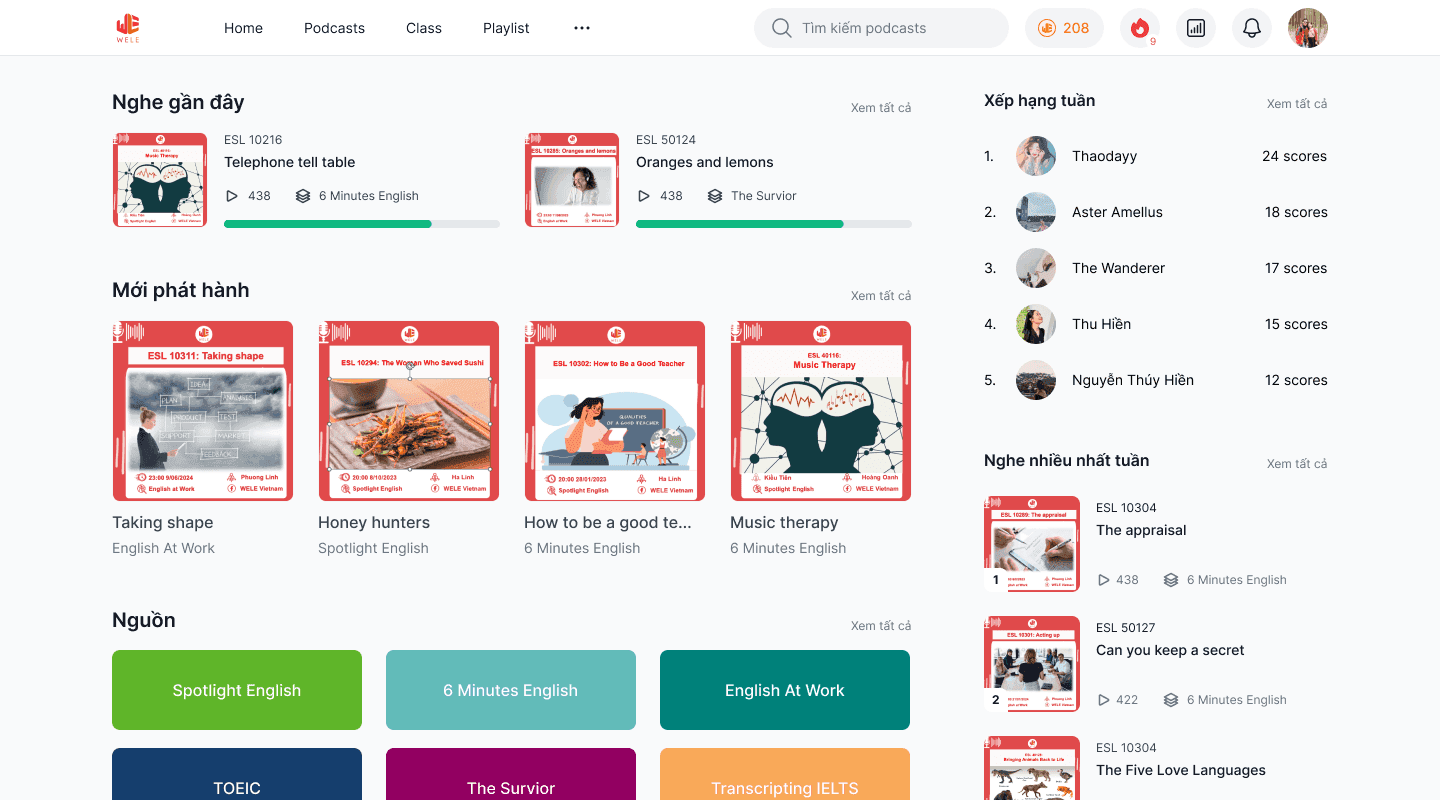
Why you listen a lot and still don't improve
Most English learners already listen quite a bit: subtitled movies, music, YouTube videos, podcasts on the commute. But when a native speaker says an ordinary sentence at an ordinary speed, they still miss it. The problem usually isn't the hours you put in. It's that the way you listen never forces your brain to process each sound.
With subtitles, your eyes read ahead and your ears just follow. With music, you learn the melody, not the words. With a podcast on while you drive, you catch the gist and skip the rest, and nothing tells you how much you skipped.
Real listening practice means having a specific task to do while you listen, and a way to know whether you got it right. The four methods below all meet that bar, each in its own way.
Four ways to practice English listening, and who each one suits
No single method can replace the other three. Each one trains a different part of listening, and each has a limit clear enough that you know when to switch to another.
Dictation
Suits people who know basic vocabulary but can't pick it out by ear, and people preparing for TOEIC or IELTS.
Listen to a short sentence, write it down word for word, then compare it with the transcript. Of the four methods, this is the only one that shows you exactly which words you missed: the -s and -ed endings, or words like of, the and have that get swallowed. The downside is that it's slow and fairly tiring. A two-minute clip can eat fifteen minutes, and in the first few days the comparison looks pretty grim.
See how dictation works on WELEShadowing: speaking along with the speaker
Suits people who want to improve listening and pronunciation at the same time.
Play the audio and speak along about half a second behind, trying to match the intonation and the pauses. Shadowing trains your ear differently from dictation: you have to hear the rhythm and the linking to keep up. It doesn't tell you which words you got wrong, so it works best on a piece you've just finished dictating.
How to combine shadowing with dictationIntensive listening with a transcript
Suits lessons too hard to dictate, or days when you're out of energy.
Listen once without looking at anything. On the second pass, read the transcript as you listen and mark where what you heard differs from the text. On the third pass, don't look again. This is much lighter than dictation, so you can do it with longer pieces. The risk is that the second pass easily turns into reading rather than listening.
Listening library with transcriptsExtensive listening: lots of it, relaxed
Suits every level, as long as you pick the right difficulty.
Podcasts, movies without subtitles, long videos on topics you like, listened to for meaning without stopping. This is what keeps your ear used to real English, and it's also the part most easily mistaken for the whole of listening practice. It only works when the material is easy enough that you understand most of it without pausing.
Pick podcasts by level
These four methods don't rule each other out. A sensible week of listening practice usually has a few short dictation sessions, a bit of shadowing on the piece you just dictated, and extensive listening in your spare moments. The mix depends on where you are: beginners should lean on dictation and intensive listening, while strong listeners should lean on extensive listening and dictate only the hard pieces.
Any tool works as long as it has a transcript to check against. Besides WELE, you can do dictation on DailyDictation or Listen A Minute, intensive listening with transcripts on BBC Learning English, and find podcasts in whatever app you already use. What sets WELE apart is that lessons come pre-split into sentences, graded word by word and sorted by difficulty, so you don't have to pick material and check answers by hand.
An honest four-week plan
This plan assumes about twenty minutes a day. It doesn't promise you'll watch movies without subtitles after four weeks. It promises that after four weeks you'll know exactly where you're weak, and you'll have a habit you can keep.
- 1
Week 1: find out where you stand
Take the listening level test so you pick lessons at the right level, instead of picking by favorite topic. Each day, dictate one short lesson with a slow, clear speaker. Don't worry about the score; just finish it and read the comparison. Note the error patterns that keep coming back, for example always losing the -ed ending, or always mixing up can and can't.
- 2
Week 2: replay your mistakes until you hear them
Keep dictating one short lesson a day, but spend a few extra minutes replaying exactly the sentences you got wrong the day before, until your ear catches the sounds you skipped. This is the part most people drop, and it's also the part that makes the difference. Your errors usually cluster into a few patterns, so this week you'll see them show up.
- 3
Week 3: add shadowing and extensive listening
After dictating, shadow that same lesson once or twice. In the evening or on your commute, listen to a podcast episode a little easier than what you're dictating, without stopping or looking anything up. If it gets to be too much, drop shadowing first, not dictation.
- 4
Week 4: step the difficulty up one level
Pick faster lessons or ones with more speakers. Your comparison results will get worse for a few days, and that's normal. At the end of the week, dictate a lesson from week 1 again to see the gap between the two attempts.
After four weeks, keep the same framework and just change the content. People who practice consistently usually see a clear difference after a few months, not a few weeks, and it shows up first on familiar topics. If you want a shorter routine for busy days, the daily English listening practice guide has a twenty-minute session already broken into parts.
The mistakes that keep you stuck
The six mistakes below show up at almost every level. They don't stop you. They slow you down without you noticing, and that's what makes them hard to fix.
- Picking lessons that are too hard
- Great lesson, favorite topic, but you catch less than half of it. At that point you're not practicing listening, you're guessing. A good lesson to dictate is one where you catch about seventy or eighty percent; the rest is where the learning happens.
- Reading the transcript before listening
- Read first, and the listening that follows just confirms what your eyes already saw. The transcript is for checking after you dictate, not for preparing.
- Mistaking passive listening for practice
- Having podcasts on all day to get used to the sound has its place, but it can't replace sitting down and doing the work. If your whole week was passive listening, you haven't practiced yet.
- Constantly switching sources
- BBC today, TED tomorrow, a new YouTube channel the day after. Every voice and speaking style takes time to get used to. Stick with one source for a few weeks before you switch.
- Practicing only with exam papers
- TOEIC and IELTS recordings are slower and clearer than real people. If you only listen to tests, you get used to a kind of English few people speak outside the exam room. Practice with real content, and going back to the tests usually feels easier.
- Skipping the replay of your mistakes
- Finish the dictation, check the score, close it. The most valuable part is replaying the sentences you got wrong until you hear them, and it only takes a few extra minutes.
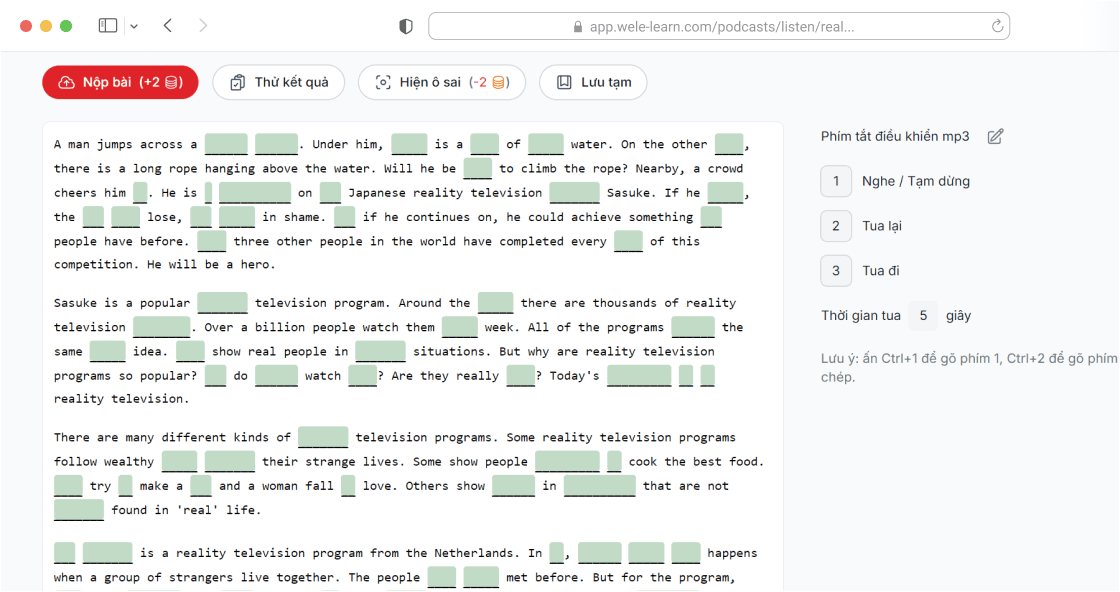
The comparison after you dictate is where three of these six mistakes show up: a lesson that's too hard is covered in wrong blanks, reading the transcript first gives a suspiciously high score, and skipping the replay means next week you miss the very same blanks.
Listening practice by topic
Sticking with one topic for a few weeks gets you further than jumping topics every day, because the vocabulary and phrasing repeat. Every lesson in the topics below has a transcript and is sorted by difficulty.
- Beginner VietnameseSimple conversations and stories for absolute beginners
- Intermediate VietnameseNews, culture, and longer narratives for intermediate learners
- Advanced VietnameseComplex topics, idioms, and literary Vietnamese
- Vietnamese Tones PracticeFocused exercises on mastering Vietnamese tones
- Business VietnameseProfessional vocabulary and workplace conversations
- Vietnamese Slang & IdiomsColloquial expressions and idiomatic phrases
Frequently asked questions
- How long should I practice English listening each day?
- About twenty minutes with a specific task, every day, lasts better than one long session on the weekend. On days you're short on time, dictating one very short lesson still beats skipping, because what you're protecting is the habit, not the minutes.
- I'm close to a beginner. Where should I start with listening?
- With short lessons, slow speakers and familiar topics. Take the listening level test so you're not picking blindly. Dictation still works at this level as long as the lesson is easy enough, and if a sentence is too long, dictate it phrase by phrase.
- Is dictation the only way to practice listening?
- No. It gives the clearest feedback on where your listening falls short, but shadowing, intensive listening with a transcript and extensive listening all have their place. Most learners combine all four, in proportions that shift with their level.
- Should I practice with British or American accents?
- Whichever you'll hear more. For IELTS, listen to plenty of British and Australian English; TOEIC uses all four accents. More important is not to stick with one accent forever: once you're used to one, switching to another will throw you for a few days, then you'll settle in.
- Is listening practice on WELE free?
- Dictation and result checking are free, no card needed. Premium unlocks more lessons and some review tools.
- How long until I see progress?
- It depends on your starting point and how consistent you are. People who practice consistently usually see a clear difference after a few months, not a few weeks, and they see it first on familiar topics. If your comparison results haven't moved after a few weeks, the lessons are usually too hard or you're skipping the step of replaying your mistakes.
Start with a lesson at your level
Take the listening level test to see which level to choose, then try dictating a short lesson. Both take about fifteen minutes and don't need an account.